Obsession, Not Passion: Inside Rebekah’s Relentless Pursuit of a Star
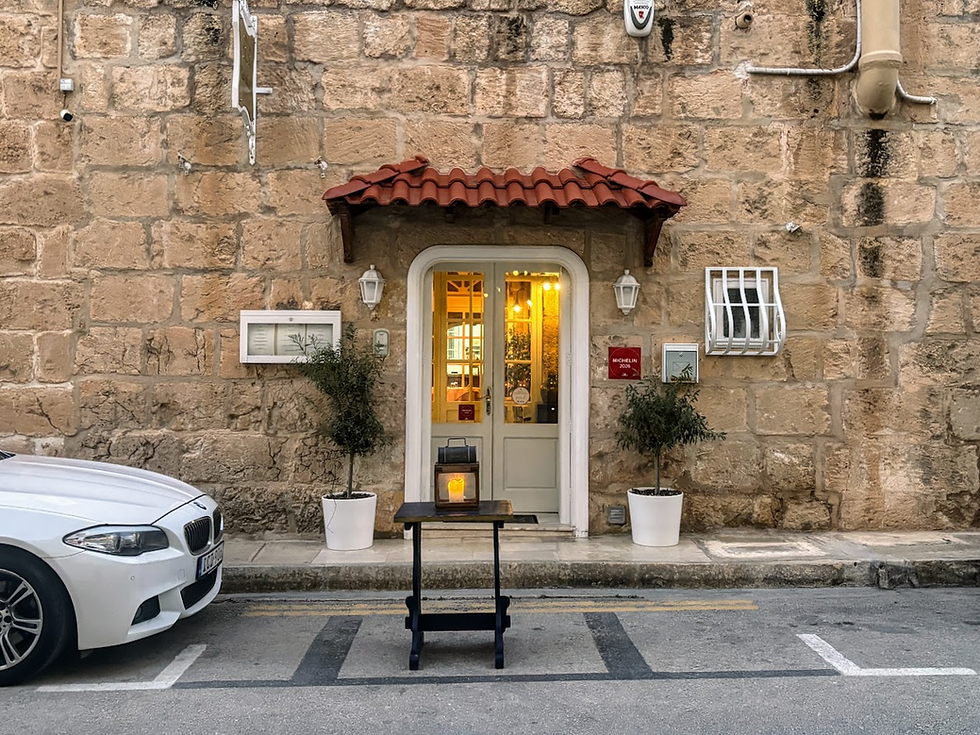
Date Visited: March 28, 2026
Restaurant: Rebekah's Mellieha
Obsession
The call came in the morning. Not a reminder email, not a polite text. A call.
Chef Patron Andrew Vella on the other end, confirming the booking like it actually mattered who was walking through his door that night. No buffer. No receptionist. Just him, checking, tightening the screws.
It brought to mind old footage of Marco Pierre White at Harvey’s, taking reservations like he was deciding who deserved to eat. Not hospitality. Control.
I’d been asking around. Kitchen people talk. They always do.
The word that kept surfacing wasn’t “talent” or “precision” or any of the usual safe praise. It was simpler. Heavier.
Obsession.
Rebekah’s sits comfortably in the Guide right now, recommended, respected. But that’s not where the conversation is. Not in kitchens, not over late drinks. The quiet consensus is that Vella isn’t aiming for comfortable. He’s hunting.
A star, sooner or later.
I’d been watching from a distance, his Instagram, the small things most people scroll past. Plates made to measure. Linen pressed so hard it looked lacquered. The kind of details that don’t earn applause but keep chefs awake at night.
So I booked the first seating. Always do. See the room before it’s been touched by the chaos.
The Machine Warms Up
I walked in alone. First one through the door.
Too many staff for a room that size. Four, maybe five bodies moving in sync, watching everything. At first it felt off, like showing up early to something you weren’t meant to see. Then you realise: this is the system warming up.
I was led into the courtyard, sealed off from the night with glass and low heat humming from overhead units. Warm, but not soft. Controlled.
Music drifted in, slow, lounge versions of songs you’d recognise if you paid attention. Stripped down, almost anonymous. Background noise engineered not to distract from what actually matters.
The table was bare in the way only obsessive places can get away with. White linen, razor-pressed. No wrinkles, no forgiveness. A napkin rolled tight enough to feel like it might snap if you pushed it.
Then Francesco appeared, maître d’, sommelier, and everything in between. The kind of role that doesn’t exist in weaker rooms. He didn’t ask. He unfolded the napkin and placed it on my lap with quiet precision.
No performance. No flourish. Just a signal.
You’re in now.
I glanced at the menu out of habit, not necessity. Tasting menu. Wine pairing. No hesitation. Places like this aren’t built for half-measures.
And then, in the periphery, the first sight of Vella.
Tall white apron. Already marked, already working. Not posing, not surveying the room like a celebrity. He was at the bar, grabbing something quick with his brigade before the doors really opened. Fuel before impact.
No speeches. No theatrics.
Just a man about to go to work.
And you could feel it, the room tightening, staff locking into place, something unspoken shifting gears.
Service hadn’t started yet.
But the machine was already moving.
No Safe Openings
I started to get the sense, somewhere between sitting down and the first pour of water, that my anonymity wasn’t as intact as I liked to believe.
Not paranoia. Something subtler. The way eyes linger half a second longer than they should. The way service tightens around you.
And then the chef himself walked the amuse out.
Not a runner. Not a junior.
Andrew Vella, placing the opening move directly in front of me.
Three small dishes. Controlled. Deliberate. Not generous, intentional.
I have a rule: bread first. Always. Ground yourself before the performance starts.
I broke it immediately.
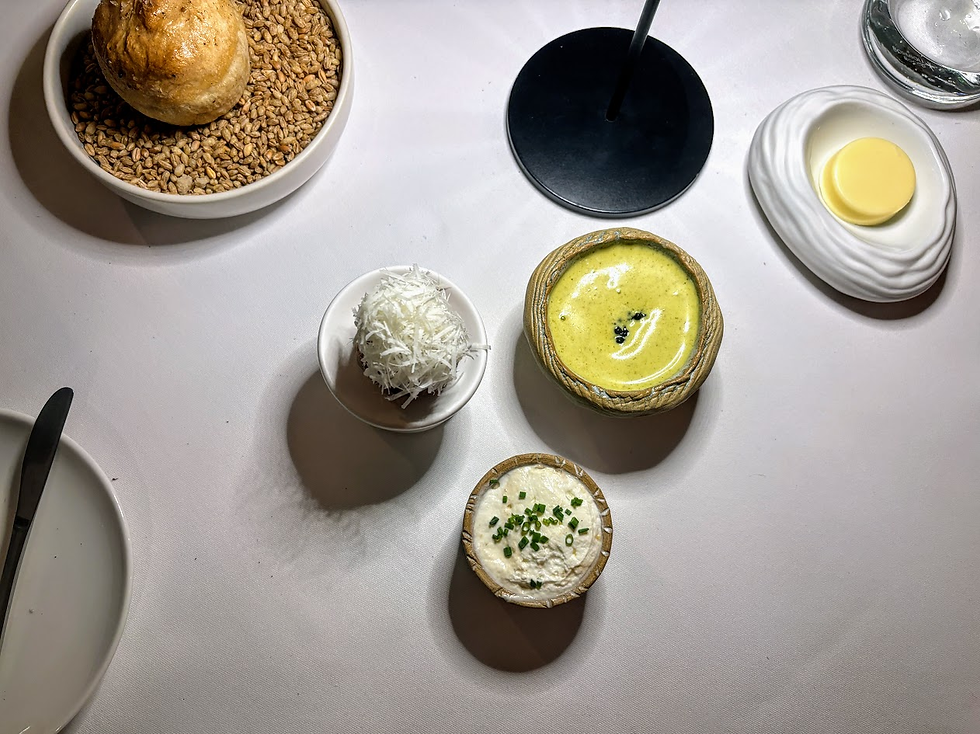
The gougère sat on a thin white pedestal, like it had been isolated for inspection. On top, a snow of pecorino the exact same volume, stacked neatly, almost like a snowman that hadn’t decided what it wanted to be yet.
One bite and it collapsed.
The shell cracked clean, no resistance, and inside, heat. A soft, savoury filling of ġbejna custard, rich without being heavy, the kind of dairy that clings to your tongue and dares you to keep up. Then the carob gulepp cut through it. Sweet, sharp, just enough to keep the whole thing from tipping into excess.
No wasted movement. No filler. Just a tight, confident opening statement.
Next, the velouté.
Pale yellow, almost suspiciously so, sitting in a clay-toned bowl that looked like it belonged to another cuisine entirely. You go in expecting something soft, maybe safe.
It wasn’t.
There was curry underneath it, sweet, spiced, not aggressive but persistent. Potatoes buried in there, soft enough to disappear if you weren’t paying attention. Raisins, too, drifting through like little pockets of sugar. It shouldn’t have worked. It flirted with that strange, nostalgic territory, something like coronation chicken stripped of its identity.
Comforting, but with a quiet edge.
Then the oyster.
This is where things shifted.
You see “oyster” and your brain fills in the rest, ice, shell, lemon, maybe a mignonette if someone’s feeling fancy. Instead, a ramekin landed in front of me, filled to the brim with crème fraîche, chives scattered across the top like it was trying to misdirect you.
Underneath, the oyster, chopped, folded into a calamansi dashi.
No theatre. No shell. No safety.
The citrus hit first, bright, almost sweet, before the brine crept in. Then the depth of the dashi followed, grounding it. Hazelnuts buried underneath gave it crunch, something to bite into so it didn’t just dissolve into a clever idea.
It wasn’t just plating. It was a small act of defiance.
I didn’t linger. I didn’t analyse between bites. I ate fast. Too fast, probably.
Only then did I remember the bread.
A tight ball of focaccia, resting on a bed of grains like it needed to be kept dry. When I tore into it, the crust fractured, properly crisp, but the inside held. Dense, elastic, warm enough to soften the whipped butter on contact.
The butter could’ve been looser. A touch more forgiving. But it didn’t matter once it hit the heat of the bread.
What mattered is that I’d already cleared the table.
The velouté bowl was gone. Missed opportunity. That bread would’ve dragged every last trace of it clean without mercy.
Instead, I sat there with empty plates, a smear of butter, and the lingering taste of that oyster still hanging somewhere at the back of my throat.
No more distractions now.
Whatever came next wasn’t going to ease me in.
The Rules of the Room
The wine came first.
Ta’ Betta’s Isabella Guasconi 2024. I already knew it. I’ve gone back to that bottle more than once, reliable, structured, the kind of thing you reach for when you don’t want surprises.
But this wasn’t about familiarity.
Francesco stood there a moment longer than necessary, watching the first sip land. Then he mentioned, almost casually, that he’d only started pouring it with the 2024 vintage.
Before that, it wasn’t good enough.
No apology. No hedging. Just a line drawn in the sand.
And that was it, you start to understand the room you’re in. Not everything gets a chance here. Not everything makes the cut. If it doesn’t hold up, it doesn’t get poured. Simple as that.
The fish tartare followed.
Or at least, that’s what they called it.
What landed in front of me looked more like a controlled experiment. A thick, weighty bowl, ceramic, slightly irregular, the kind of thing that feels expensive without trying too hard. On top, nothing but daikon. Paper-thin slices, layered with precision, cut into the shape of a Michelin star.
Subtle, if you ignore what it’s actually saying.
Then the dashi hit the bowl. Truffle, heavy on the nose, immediate, unapologetic. For a second it threatened to take over completely.
It didn’t.
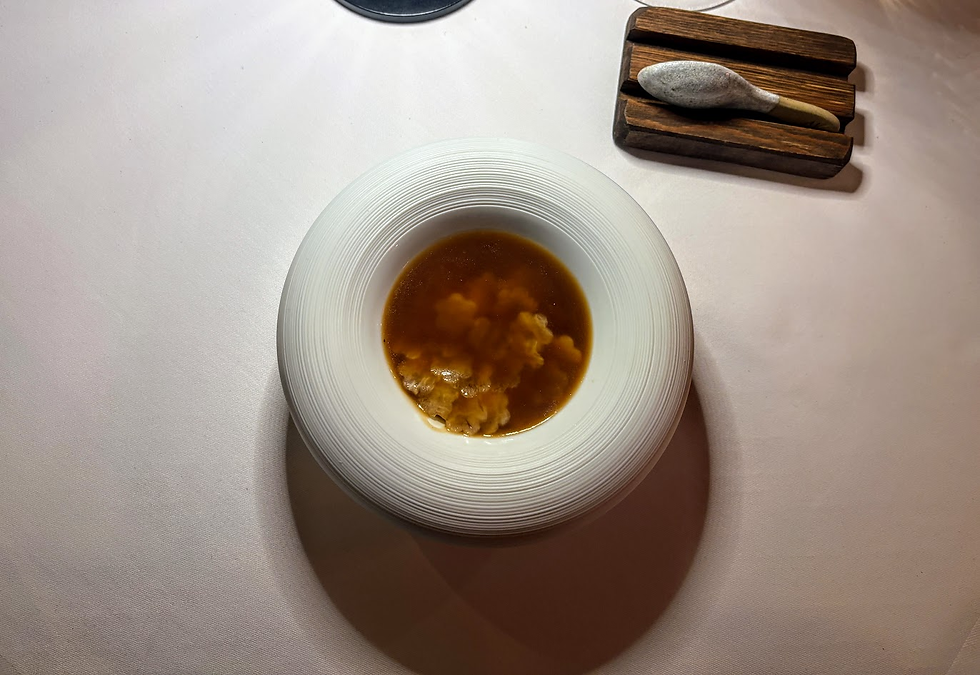
The daikon cracked under the spoon, clean, sharp, breaking up what should have been a soft, almost lazy dish. Underneath, the fish finally showed itself. Not shouting. Just there, steady, briny enough to remind you what you’re eating before slipping back under the surface again.
It played a strange game. Hide. Reveal. Disappear.
You spend half the dish forgetting it’s tartare at all. Then it comes back, just to prove it hasn’t gone anywhere.
By the time I finished, I wasn’t sure if it was restraint or control. Maybe both.
I said something to the waiter, half a question, half a challenge, and he nodded.
Signature dish.
Of course it was.
He flipped the spoon over before clearing it. Subtle, almost rehearsed. At the base, engraved clean into the ceramic:
AV.
Andrew Vella.
Even the spoon had his name on it.
Not branding. Not vanity.
Ownership.
The table was reset in seconds. Crumbs gone. Lines restored. Like nothing had happened.
They offered more bread.
I hesitated for a second, just long enough to consider it, then shook my head.
No filler now.
If this place had a rhythm, I wasn’t going to interrupt it.
The next glass landed.
Laurenti Vermentino. Familiar territory again, but by now, that didn’t mean comfort. It meant they’d decided it deserved to be there.
Nothing accidental.
The plate that followed looked restrained to the point of arrogance. Three tortellini. No more. Sitting in a wide white bowl like they’d been spaced out on purpose, each one given room to breathe.
Then the sauce came tableside.
Curry Breton.
It pulled me somewhere else for a second, one of those stories that floats around Maltese kitchens, half joke, half truth. Some British Army cook throwing curry into rabbit stew decades ago, and suddenly it sticks. Becomes tradition. No one questions it anymore.
This felt like someone did question it.
The tortellini were tight, properly sealed, the pasta with bite, not soft, not forgiving. You had to work for it just enough. Inside, rabbit. Clean, focused, no excess. No attempt to dress it up as something else.
Then the curry hit.
Not heavy. Not muddy. Warm, spiced, with a quiet acidity running through it that kept everything upright. Beans folded in, ful, soft but not collapsing, giving the whole thing something to push against.
It walked a line it had no right walking.
Familiar, but not nostalgic. Controlled, but not sterile.
Three pieces. That was all you got.
And that was enough.
Between clearing the plate and the next pour, the room shifted slightly.
A couple walked in. No reservation.
You could feel it immediately, that small disruption, the kind most places absorb without thinking. Extra covers mean extra money. Easy decision.
Not here.
Francesco stepped in, polite but firm. Apologised. Turned them away.
The room was still half-empty.
That’s what made it land.
As he walked back, I caught it, not meant for me, but said clearly enough.
Thirty covers tonight. Better to do them properly than squeeze in one more and compromise.
No hesitation. No negotiation.
The kind of decision that costs you money in the short term and buys you something else entirely.
The table was reset again. Quiet. Precise.
By now, the pattern wasn’t a pattern anymore.
It was a rule.
Control Under Pressure
The next glass didn’t just arrive, it came with a script.
Francesco had a rhythm by now. Not rehearsed in a fake way, but practiced. Deliberate. He didn’t just pour, he walked you through it. Where to hold it. When to smell. When to wait.
Not instruction. Calibration.
White Antonin Riserva 2022.
He let it sit for a second before saying anything else. Then: oak, but controlled. A sweetness that leans toward caramel, a soft edge of vanilla, but nothing that tips over into dessert. It stayed upright.
You take a sip and realise, it’s not trying to impress you. It’s trying to hold its ground.
Before the plate landed, the room shifted.
A door I hadn’t paid attention to opened, and suddenly the place doubled in size. Lights flicked on. Tables already set, already waiting. The earlier staff numbers made sense now, they weren’t overstaffed, they were preparing.
This wasn’t a small room running a tight service.
This was a system about to take on weight.
Somewhere in that transition, the light above my table flickered. Just once. Easy to ignore.
I didn’t.
Neither did they.
Before I could even look up properly, someone was there. A quiet apology, a replacement swapped in cleanly, no fuss, no disruption. Like the mistake had been anticipated before it happened.
You start to understand, nothing here is left to chance. Not even the things that go wrong.
Then the dish arrived.
A square of fish, skin side up, seared hard enough to leave it properly marked. Not decorative, earned. The kind of crust that resists for a second before giving way.
Next to it, haricots verts pulled into a tight bundle, almost too precise, topped with mussels that still carried the sea with them. Then the sauce, poured at the table again, shellfish, rich, slightly mineral, spreading slowly between everything like it was finding its place.
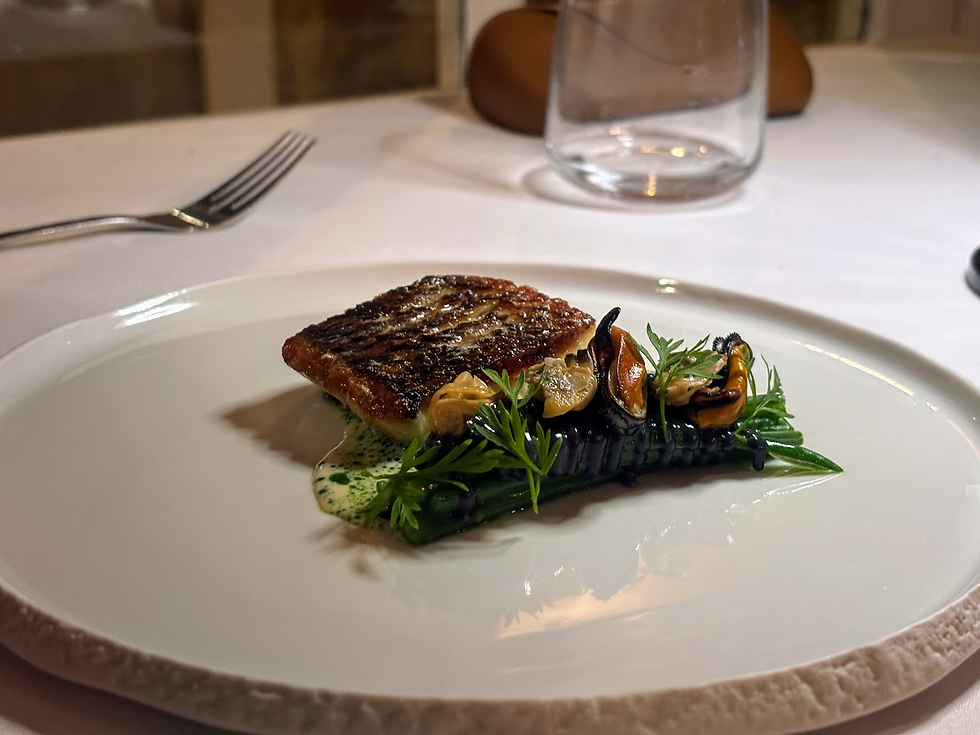
I took it apart first.
Fish alone, soft, almost too gentle until the crust kicks back.
Beans, clean, green, snapping just enough to remind you they’re alive.
Mussels, brine, direct, no interference.
Then the wine.
And it clicked.
The weight of it. That quiet oak. The way it held against the sauce instead of disappearing into it. This wasn’t pairing for contrast, it was reinforcement. Layer on layer, nothing cancelling anything out.
You go back in, this time with everything together, and it tightens. The dish stops being components and becomes something else entirely.
There’s no slack anywhere. No excess. No apology.
By now, the room behind me was filling. The machine had started taking on pressure.
And at my table, things were only getting heavier.
The next glass came in darker.
A continuation, but heavier.
Red Antonin Riserva 2020.
Francesco didn’t rush this one. He let it sit in the air for a second before speaking, like it needed introduction.
Last glass in the cellar.
Not metaphorically. Literally the last one.
He’d held onto it. Refused to pour it until November. Too young before that, he said. Not ready. Not worth serving.
Same rule. No exceptions.
You take a sip and it lands warm, not aggressive, not trying to dominate, but settled. Like it’s finally where it’s supposed to be.
At this point, you stop questioning the decisions.
I’d skipped the supplement. No Iberico. Stayed with what was written.
What arrived was restrained to the point of severity.
A cuboid of pork, clean edges, blushing just enough to remind you it hadn’t been pushed too far. On top, a quenelle of gherkin and raisin purée, sharp, almost confrontational in colour. Next to it, grilled lettuce, slightly wilted at the edges, carrying heat. Draped over that, sheets of guanciale so thin they barely held their shape.
It didn’t look indulgent.
It looked controlled.
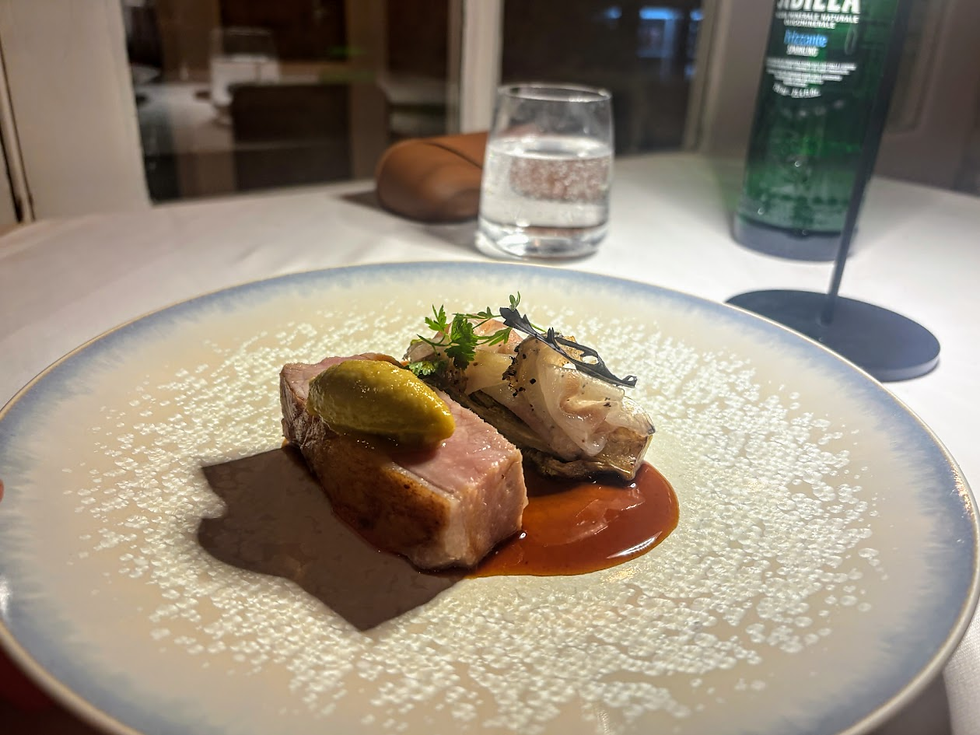
Cut into the pork and it gave way immediately, soft, but not collapsing. There was structure there. Fat, but held in check. The gherkin and raisin cut through it, sweet at first, then turning, pulling everything back from the edge before it got too comfortable.
The lettuce surprised me.
Smoky, slightly bitter, still holding onto a crunch underneath. The guanciale melted into it, salt and fat threading through the leaves. It landed somewhere in the territory of a Caesar, stripped back to its bones, no dressing, no theatrics, just the mechanics of it laid bare.
Nothing extra. Nothing missing.
You eat it and realise, this isn’t about richness. It’s about control over richness.
The kind that doesn’t ask you to loosen your belt. Just keeps you locked in.
By now the room had filled.
Couples mostly. Close tables. Low voices. The kind of place people choose when they want the night to mean something. Not casual. Not accidental.
And through it all, Andrew Vella moved.
Not stuck behind the pass. Not hiding in the kitchen.
He checked in himself, brief, direct, no small talk. Just enough to confirm everything was landing the way it should.
Then he was gone again.
Back into the machine.
By now it was clear, this wasn’t just about cooking.
It was about control over everything that touched the plate.
And there was still more to come.
Nothing Extra
I went for the cheese.
No theatrics here. No reinterpretation. Just three names that have survived longer than most trends ever will, Comté, Gruyère, Morbier.
A quiet plate after everything that came before.
But even here, nothing was careless.
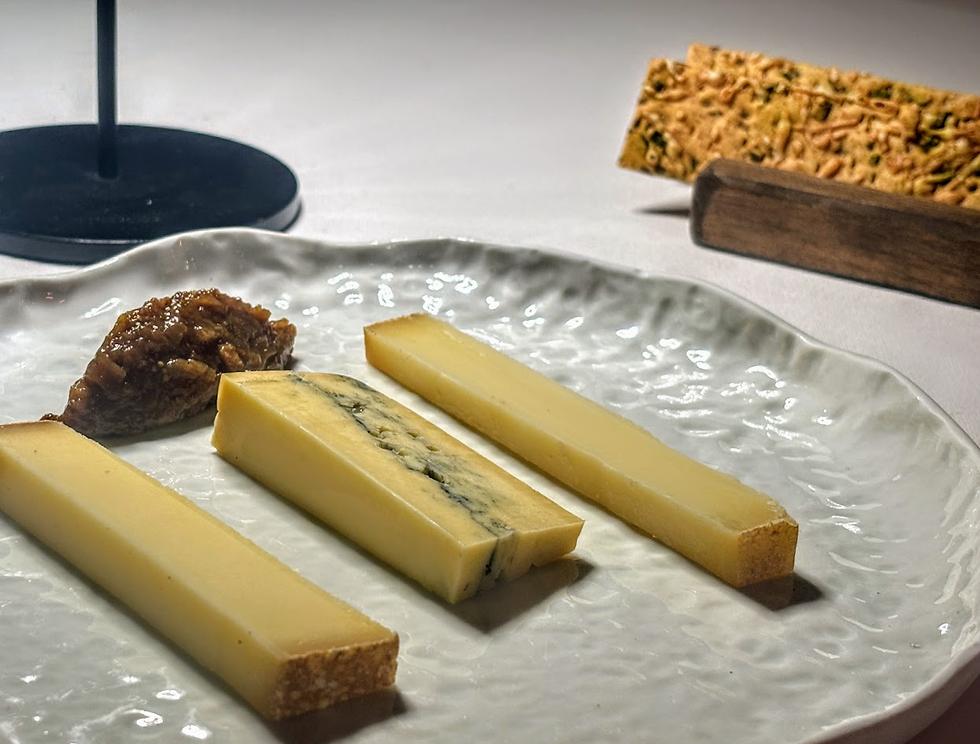
The Comté had that slow, nutty depth, the kind that builds instead of hitting you all at once. Gruyère, softer, more rounded, melting slightly as it sat. The Morbier cut through both of them, that faint bitterness running through the middle like a line drawn on purpose.
Fig chutney on the side. Dark, sticky, just enough sweetness to pull everything together without turning it into dessert. Crackers so thin they barely held, laced with cheese themselves, like they didn’t trust anything on the plate to stand alone.
It felt almost traditional.
Almost.
But even in restraint, there was that same underlying pressure, nothing extra, nothing lazy. Even simplicity had been tightened.
Then the pre-dessert arrived, and whatever calm had settled didn’t last long.
A small bowl. Bright, almost aggressive in colour.
An orange quenelle of mandarin sorbet sitting over a deep red pool of berries.
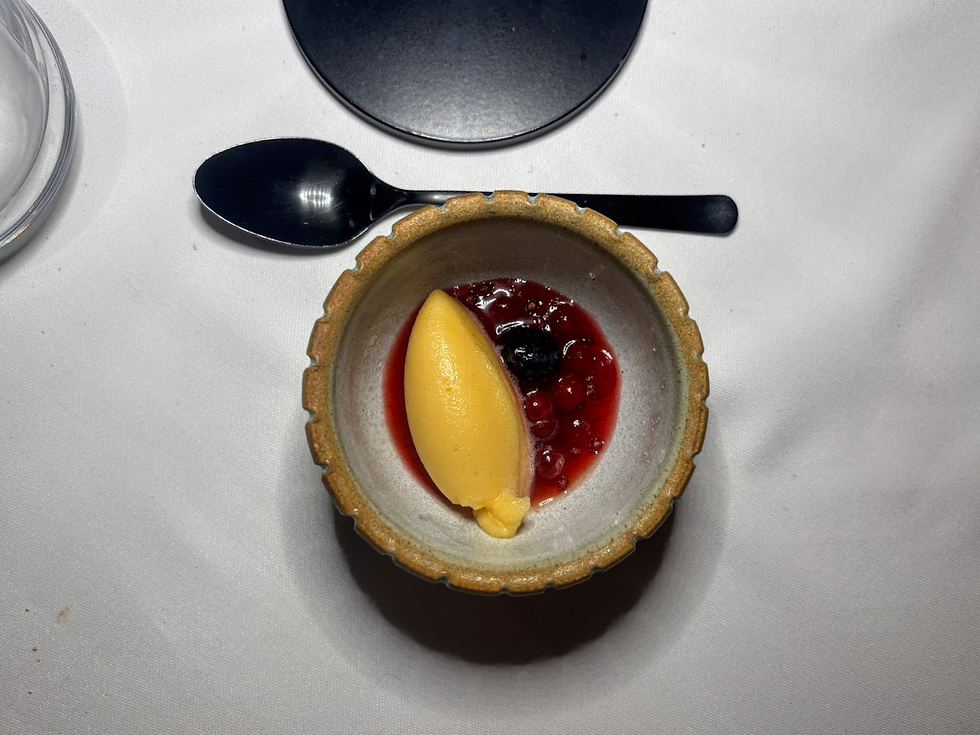
And one phrase, dropped in passing:
Honey vinegar.
It didn’t make sense on paper.
It did on the spoon.
Cold first. Then sharp. Then something sweet trying to hold it all together before the acidity takes over again. It pulled at the sides of your tongue, made your jaw tighten slightly, like your body didn’t fully trust what it was tasting.
And then it clicked.
Like a Christmas cake, spiced, dense, familiar, but dragged out into the sun and forced to wake up. Stripped of its weight, left with just the memory of it.
It reset everything.
Not gently. Not politely.
Just enough to remind you that the meal wasn’t done with you yet.
Behind the Curtain
Dessert came with a choice.
On the menu: an After Eight. Mint, chocolate, safe territory dressed up to look sharp.
But then the offer, something new. Not on the menu yet. Still being worked on. Next week, maybe.
I didn’t need convincing.
Partly because mint and chocolate has never done much for me. Mostly because this felt like stepping half a foot behind the curtain, seeing what Andrew Vella is still adjusting.
The wine followed.
Ġużé Passito.
Francesco slowed down again for this one. Explained how it takes three times the usual amount of grapes to get there. Concentration. Reduction. Loss, turned into something else.
You taste it and it sits somewhere between dessert and restraint. Like a port that decided not to show off.
Then the plates.
Two bowls.
One clean, almost minimal, a quenelle of strawberry sorbet, sharp in colour, holding its shape like it meant it.
The other more layered. Cream. Fresh strawberries. Pastry. And over everything, a thin, translucent red disc, stretched so fine it barely looked solid.
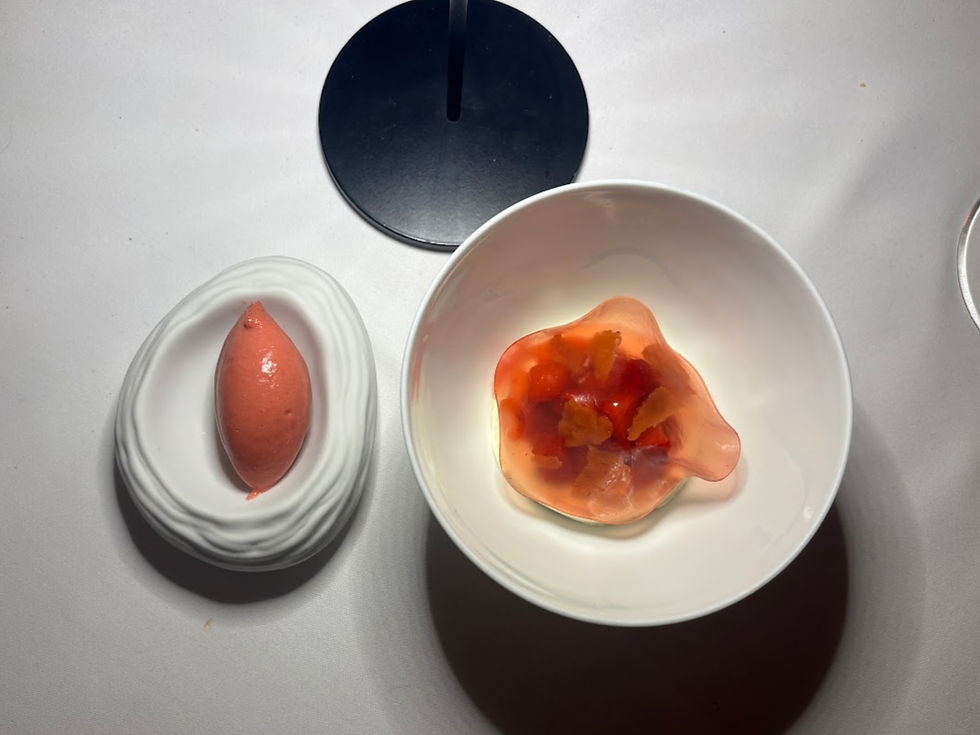
You break through it.
And it falls somewhere familiar, but not quite. Like a strawberry cheesecake that’s been taken apart and rebuilt by someone who didn’t trust the original version.
The cream wasn’t light. It had weight. A slight chew to it. The pastry underneath carried butter properly, not flaky for the sake of it, but structured. The strawberries leaned just past fresh, softened, coaxed into giving more than they normally would.
It tasted like summer in Mġarr.
Not the postcard version. The real one, heat sitting on your skin, fruit pushed to its edge.
Then the sorbet.
Cold, clean, no crystals. It cut straight through everything else, resetting the palate whether you asked for it or not.
The last bite came from the chef himself.
Andrew Vella back at the table, placing the petit four down like he had at the start.
A small dome. On top of it, a pastry, again, that same Michelin star shape. Subtle the first time. Less so now.
A dot of cream. Tiny points of mint jelly. Purple petals, almost unnecessary, but controlled enough not to tip into decoration for its own sake.
One bite.
Gone.
Butter, sugar, precision.
And that was it.
No lingering sweetness. No drawn-out ending.
Just the quiet realisation that nothing here, wine, food, service, even the things still being tested, had been allowed onto the table without earning its place.
Obsession, all the way through.
The Verdict
I leaned back.
Espresso in one hand, limoncello in the other. Bitter, then sweet. A rhythm you fall into without thinking about it.
The room was full now. Conversations low, controlled. Glassware moving in clean lines. No panic, no noise. Just a system doing exactly what it was built to do.
€182.
Not casual. Not forgettable. But by that point, it didn’t feel like a number you argue with. It felt like the cost of entry into something very specific.
Not luxury. Not indulgence.
Control.
I came in with a question, same one I ask whenever I walk into a place like this.
Does it deserve its place in the Guide?
That part’s obvious. Of course it does.
But that’s not really the question anymore.
Because sitting there, finishing the last of the espresso, it’s clear this place has already outgrown that conversation.
Rebekah’s isn’t operating at a “recommended” level.
It’s operating at a starred one.
Not in theory. Not in potential.
Now.
Every decision, from the wines held back until they’re ready, to covers turned away at the door, to the smallest details stamped with the chef’s mark, points in the same direction.
No compromises. No shortcuts. No passengers.
This isn’t passion.
Passion is loud. Messy. Forgiving.
This is obsession.
And places that run like this don’t stay overlooked forever.
The only question is how long it takes for Michelin to catch up.