It Feeds You Until You Surrender
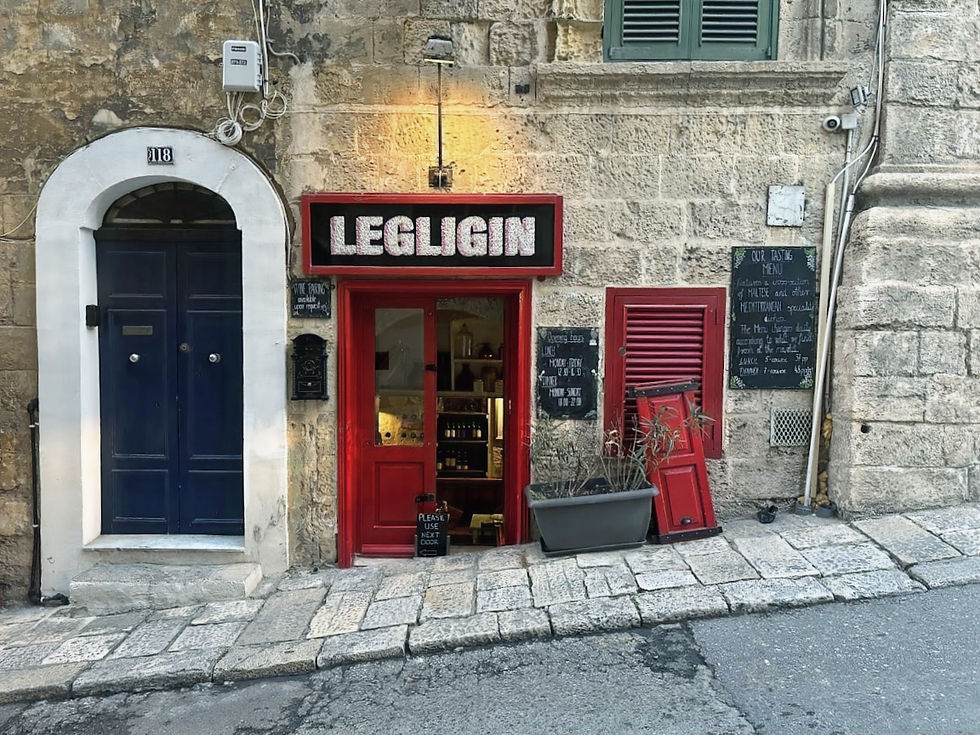
Restaurant: Legligin, Valletta
Visited on: February 25, 2026
First Stop: A Restaurant I Thought I Knew
I hadn’t even taken off my jacket.
Cats fed. Shoes still on. A faint smear of red wine on my cuff. I was still riding the warmth, that soft, dangerous afterglow where the room hasn’t quite left your body. My stomach tight. My skin slightly damp. The kind of fullness that borders on regret.
And I knew I had to write.
Because if I waited until morning, the edges would blur. The Guide would start whispering in my ear. Memory would get polite.
This is where it begins.
Forty-seven restaurants. Stars. Bibs. Recommended. A year of chasing a tyre company’s blessing across an island small enough to drive end to end in under an hour.
So I started where I always do.
Legligin.
Not because it’s convenient. Not because it’s easy. But because I’ve been walking down those narrow Valletta steps for ten years now. Long before Michelin decided Malta was worth the airfare.
Legligin has always felt like slipping into someone’s kitchen after hours. Stone walls sweating humidity. The low hum of conversation bouncing off arches. Bottles lined up like quiet witnesses. No menu in the traditional sense, just a sequence, decided for you. You eat what you’re given.
That’s trust. Or surrender.
It sits in the Guide now as a Recommended entry, a quiet nod, not a star, not a Bib. Just acknowledgment. As if Michelin walked in, ate, and said: yes, this counts.
But counted against what?
On my umpteenth visit, I tried to see it without nostalgia. That’s harder than it sounds. Familiarity is a dangerous seasoning. It softens judgment. It forgives small missteps. It lets you confuse affection with excellence.
Tonight I paid attention.
To the pacing between plates.
To the way the wine was poured, generous or measured.
To whether the room felt like theatre or like work.
Because this project isn’t about whether I like a place.
It’s about whether the Guide is right.
And that’s a heavier question than it looks.
Virgil in Valletta
In Dante’s descent, it was Virgil who held the lantern.
At Legligin, it was Thomas.
Thomas runs the floor at Legligin, the son of the guy who opened up the place two decades ago. From the moment I slid into my chair, still carrying the evening air from Valletta’s steps, he was there. Not hovering. Not stiff. Present. A steady orbit around the table. He poured the first glass before I asked. He explained the sequence without reading from a script. He didn’t recite dishes; he told stories.
Seven courses. Wine pairing included.
Not a tasting. A commitment.
I braced for it the way you brace for a long Mass, knowing there would be ritual, rhythm, repetition. Knowing you don’t get to choose the readings.
Legligin has always felt Maltese to me. Not the postcard Malta. Not the folkloric version with lace and luzzu boats. The other Malta. The one built on stone, salt, stubbornness. The one that feeds you until you physically cannot continue.
The food leans into that identity. Local wines. Familiar ingredients treated with respect but not preciousness. No tweezered micro-herbs. No architectural smears. Just plates that look like they belong to someone’s grandmother, because sometimes they did.
Not one plate matched another.
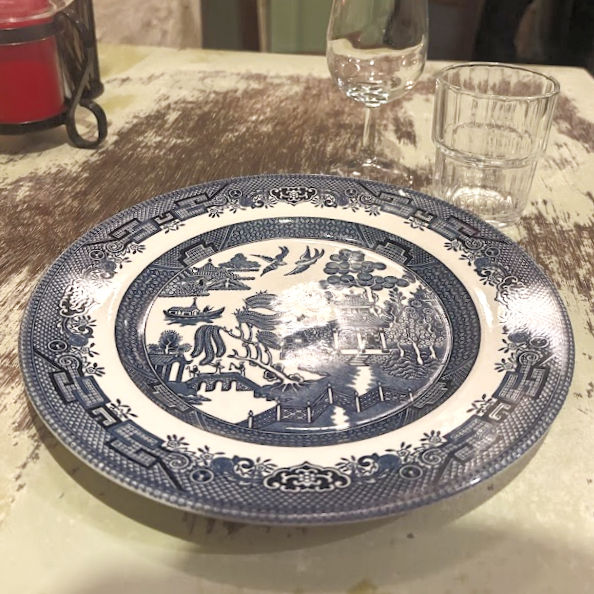
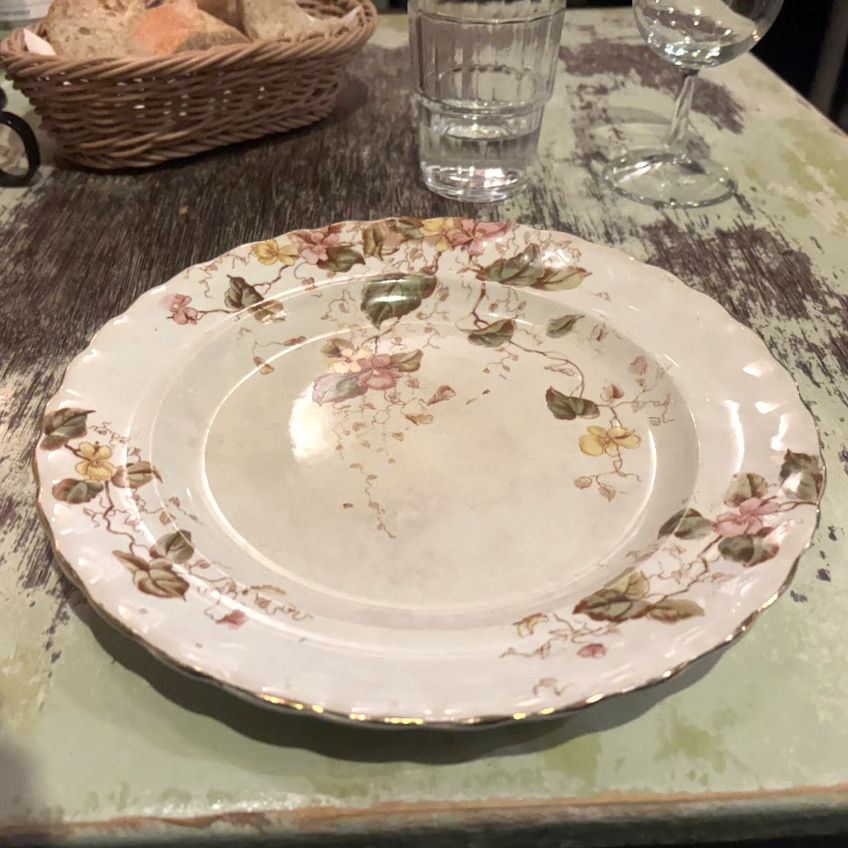
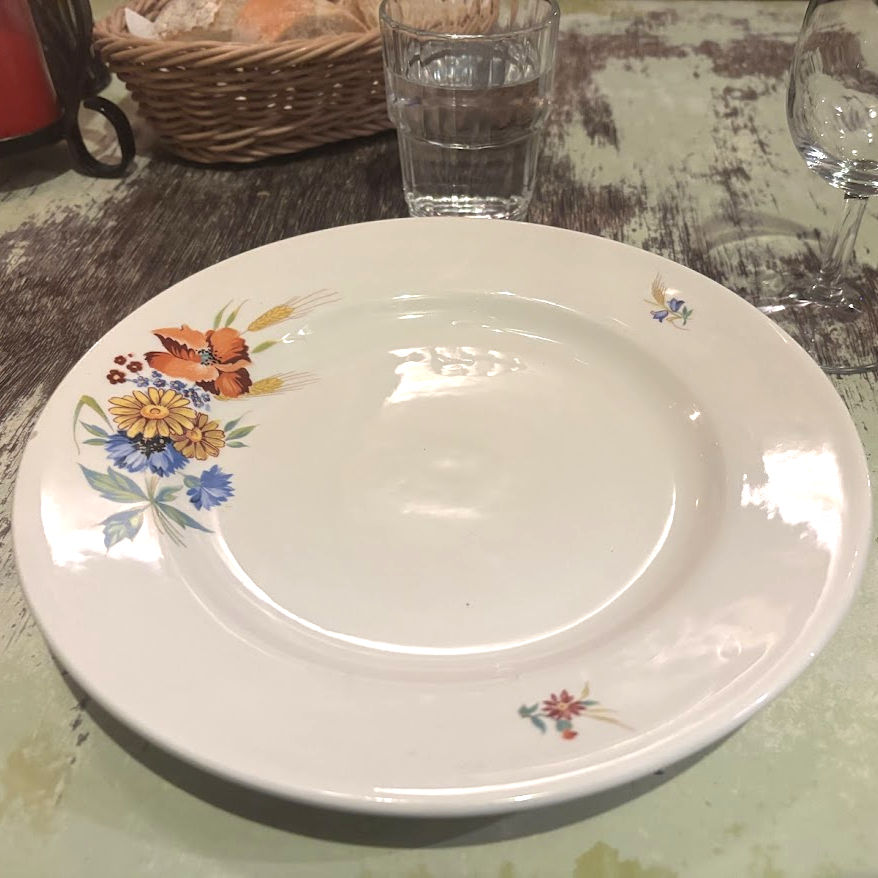
Thomas told me he sources them from flea markets abroad and from local sellers. That he travels with an extra suitcase just to bring them home. I pictured him in some European antique market, weighing ceramic against baggage allowance, deciding which bowl deserves a seat on the flight back to Malta.
It’s eccentric. It’s charming. It’s branding, whether intentional or not.
Because here’s the question: is the mismatched crockery an extension of Maltese hospitality, improvised, collected, layered over time? Or is it theatre? A visual cue whispering rustic authenticity to diners who need reassurance they’re eating something rooted?
Thomas, to his credit, doesn’t sell it like a gimmick. He speaks about the plates the way you’d talk about rescued strays. Each one has a story. Each one has mileage.
And as the courses began to land, one after another, steady, generous, unapologetic, I realised something.
This wasn’t just dinner.
This was a defence.
A defence of what Maltese food looks like when it refuses to dress up for anyone.
Bread Is Infrastructure
I’d planned it like a small ambush.
Six p.m. The first seating. No warmed-up room. No late-night looseness. I wanted the place before it found its rhythm, before the second bottle of wine softened the edges.
I arrived too early.
A cook sat outside the red door, cigarette balanced between two fingers, exhaling the last quiet minutes of her day. Through the crack of that door I caught a glimpse of the pre-service ritual, staff gathered tight, heads inclined. A briefing. Dishes reviewed. Wine pairings aligned. It wasn’t theatrical. It felt operational.
Good.
At exactly 18:00, I walked down the familiar steps.
Thomas, and at this point, we were strangers, asked the standard question: “Have you been before?”
I told him why I was there.
Forty-seven restaurants. One year. First stop. Blind tasting. Wine pairing included.
There was a flicker in his eyes, not nerves, not quite. Something closer to excitement. As if he’d been handed a heavier barbell and was eager to lift it.
“Then we’ll have some fun,” he said.
Within seconds, a basket of bread landed on the table.
Heaped. Generous. Slightly warm.
That basket would become my second companion for the night.
It never left.
Not between courses. Not when plates were cleared. It stayed there like it does at every Maltese Sunday lunch, permanent, unquestioned, essential. Bread isn’t a starter here. It’s infrastructure.
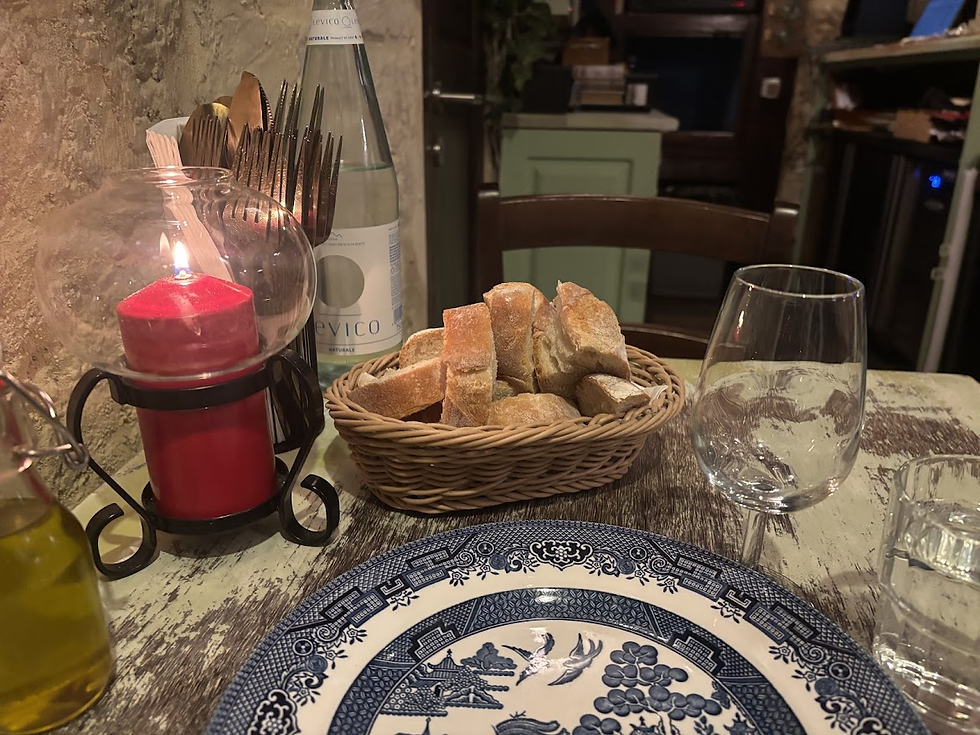
Next to it, a small bottle of olive oil. Dark, almost moss-green, thick enough to cling to the glass. When poured, it moved slowly, nutty on the nose, with that faint bitterness at the back that tells you it hasn’t been neutered for export.
The bread had just enough resistance. Soft inside, but structured. It could take punishment. It could be dragged through oil, through sauce, through whatever reduction or jus the kitchen threw at me.
Because that’s what it’s for.
Tnaqqir.
Plate cleaning. Sauce chasing. The final, unapologetic swipe.
And here’s where it gets interesting.
In more polished dining rooms, the kind that posture for stars, bread is controlled. Removed. Replaced. Managed like a prop.
At Legligin, it just sits there.
Unbothered. Abundant. A quiet act of defiance against restraint.
Michelin might call that rustic.
Maltese households call it normal.
And as the first course approached, I realised something.
If this was going to be a challenge, it wouldn’t be about technique.
It would be about whether abundance still has a place in a Guide that worships precision.
Tnaqqir and the Opening Salvo
Before every course, the wine arrives first.
A quiet declaration of intent.
I’ve done the pairing here more times than I can count, and that’s part of Legligin’s hold over me, the way it sneaks new Maltese bottles into your bloodstream without ceremony. Some favourites return like old friends. Others introduce themselves with a handshake and a dare.
The night opened with Ta’ Mena’s 2023 Juel Vermentino.
Steel-aged. Clean. It cut straight across the palate, citrus peel, a faint saline edge, that sharp, green bite that wakes you up and says: pay attention. No oak to hide behind. Just acid and clarity.
Good. Because what followed needed a blade.
Tnaqqir.
The word alone carries accusation. Every Maltese great aunt will tell you it’s the snacks that make you fat, not the half slab of butter melting into bread at Sunday lunch. Never the butter.
At Legligin, tnaqqir is how the night announces itself.
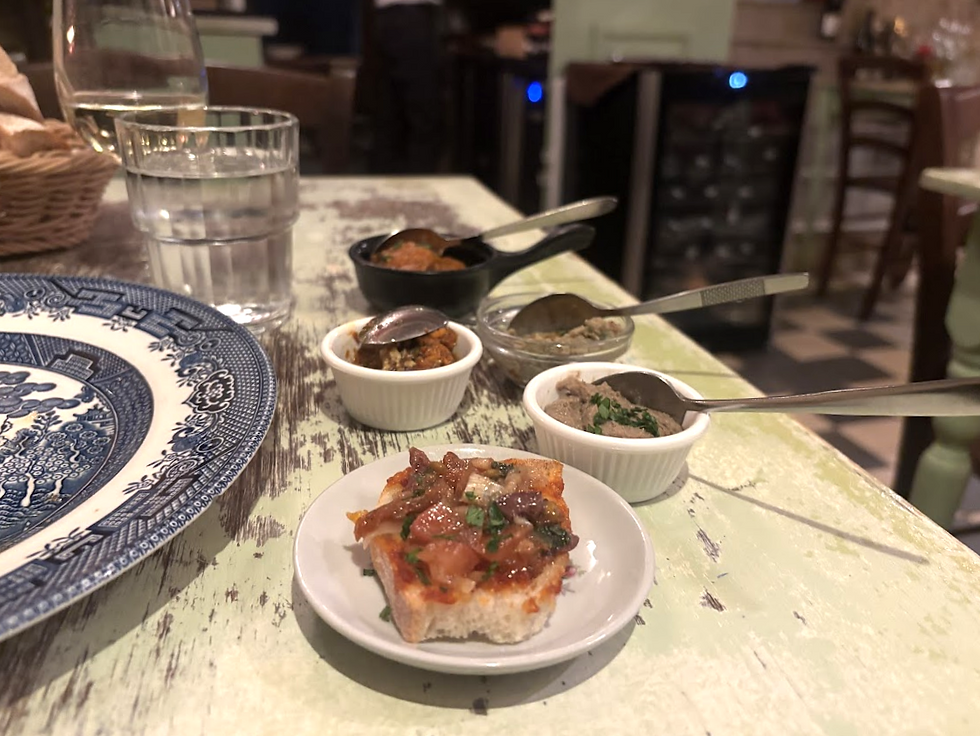
First: ħobż biż-żejt.
Yes, it translates to bread with oil. And yes, that translation is useless.
The bread was soaked, unapologetically, until the crumb drank its fill. A thick smear of tomato paste. Chopped fresh tomatoes bleeding into it. Red onion for bite. Parsley for lift. It’s the kind of thing you get at a kazin on a plastic chair under fluorescent lighting.
Here, it lands on mismatched ceramic with better wine in your glass.
Not refined. Not deconstructed. Just executed with conviction.
Then the ramekins.
Three of them. Small. Heavy. Dangerous.
Rabbit liver pâté first. Silky, iron-rich, just sweet enough to feel indulgent. It clung to the bread like it had no intention of letting go.
Bigilla next. Crushed broad beans, dense and stubborn, crowned with chilli oil. Earthy. Salty. Then that slow-building heat, not enough to scare you, just enough to remind you this island has always traded in spice.
Then arioli.
Sun-dried tomatoes. Anchovies. Even crushed galletti worked in for body. It hit with umami, deep, savoury, slightly briny, the kind of flavour that makes you reach instinctively for more bread without pretending otherwise.
I wiped each ramekin clean.
Partly greed.
Partly respect.
Partly because I’m told the vintage plates don’t survive the dishwasher, and I like to imagine I made some porter’s night easier.
Finally, two medallions of Maltese sausage, stewed in tomato.
Tender. The casing softened, surrendering into the sauce. Coriander rising through the steam, that unmistakable, a slightly citrusy warmth that defines Maltese sausage when it’s done properly. Not aggressive. Not loud. Just there, humming beneath the pork.
The tomato brought sweetness, yes, but also acidity, keeping the fat in check, letting the spice breathe instead of suffocate.
It wasn’t plated for elegance. It was plated to be eaten.
And eaten properly, with bread.
The Vermentino sliced through it all.
Here’s what struck me.
This wasn’t an amuse-bouche. It wasn’t a delicate prelude designed to impress inspectors.
It was abundance.
Bread that never leaves. Dips that demand seconds. Sausage before the “real” courses even begin.
Michelin tends to reward restraint. Precision. Control.
Legligin opens with generosity.
And as I tore another piece of bread and dragged it through the last streak of tomato and oil, I wondered - Is generosity something the Guide truly values?
Peasant Food Under Inspection
The next glass arrived before the bowl.
2024 Blanc de Cheval from Marsovin.
Chardonnay. Ramla Valley, Gozo.
On the nose, it carried that faint coastal whisper, not theatrically saline, just a reminder that this island is small and the sea is never far. Green fruit. A flicker of wild herb.
Bright acidity that kept its shoulders squared.
At the next table, I overheard the French sommelière half-muttering to a guest about the name, a playful jab at Cheval Blanc. It wounded her tricolour pride slightly. You could see it. But even she conceded, with a tight smile, that the wine held its own.
That tension amused me.
Because what landed next in front of me would have no patience for French sensitivities.
A small white bowl.
Soppa tal-armla. Widow’s soup.
Not a consommé. Not a velouté. No linguistic gymnastics. Just soup.
An orange broth, lightly shimmering from olive oil and slow simmering. In the centre, a pristine white ġbejna moxxa, fresh goat’s milk cheese, barely holding its shape, like a quiet island in the middle of something older and deeper.
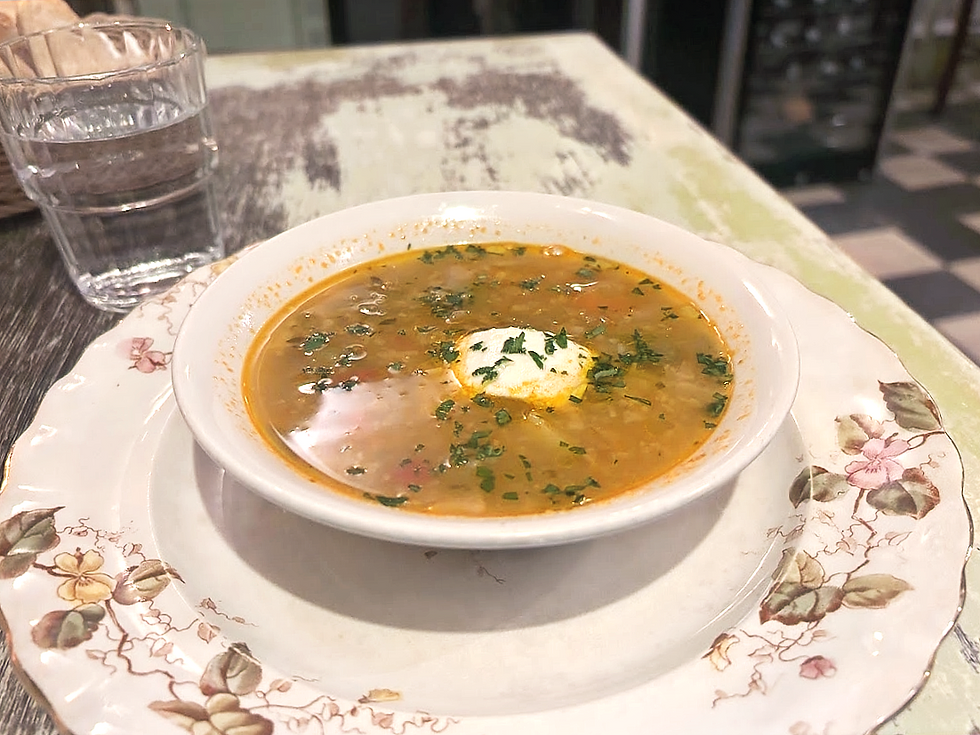
Thomas leaned in. Possibly the oldest Maltese recipe, he said.
Which is to say, not a recipe at all.
Because soppa tal-armla was built from what was there. Seasonal vegetables. Whatever Pitkali offered on Tuesday or Saturday. The ġbejna sourced from Ta’ Żeppi in Siġġiewi. No fixed blueprint. Just survival, repetition, inheritance.
I dug in.
The broth was warm and spiced, not aggressively, but enough to hum. There was depth from slow-cooked vegetables collapsing into themselves, thickening the liquid naturally. A quiet heat lingered at the back. The ġbejna softened with each spoonful, turning creamy, folding into the broth without dissolving entirely.
This wasn’t delicate.
It was grounding.
Every spoonful demanded another, and I obliged, chasing it with the Chardonnay, whose acidity cut through the richness and reset the palate without overpowering it.
Here’s the thing.
Michelin often rewards complexity. Technique layered upon technique. Reduction on top of precision.
This was peasant food.
Vegetables. Cheese. Time.
And yet, in that bowl, there was clarity. No gimmicks. No apology.
I scraped the bottom clean with bread, of course I did, and as I wiped the last orange streak from the bowl, I wondered:
Does the Guide truly recognise something like this?
Family, Not a Brigade
I was in it now.
The wine had hit that precise point, not sloppy, not dulled, just enough warmth to loosen the shoulders and sharpen appetite. I’d arrived hungry on purpose. Empty stomach. Clear head. No interference.
The dining room still hadn’t filled. Good. There’s honesty in a half-set room.
I asked Thomas about the beginning.
He told me his father started Legligin alone. One room. No kitchen to speak of. Just belief and stubbornness. Over time, one room became three. A proper kitchen followed somewhere in between. The walls didn’t just expand, they absorbed history.
Thomas himself had worked in Michelin environments abroad and locally. Structured brigades. Star-chasing pressure. Polished choreography.
But when the family called, he came back.
That matters.
His chef? Isaac Vassallo Medici (known affectionately as Chef Pupu) a childhood friend. Not a hired gun flown in to secure prestige. Not a consultant.
A tight-knit unit. History baked in.
That’s different from a restaurant assembled to impress inspectors.
No Foam, Just Fish
The next wine arrived.
Camilleri Wines 2025 Laurenti Sauvignon Blanc.
Thomas leaned closer. “You’re probably one of the first to try this. Launched five days ago.”
There’s something intoxicating about being handed something that new.
It opened floral, then drifted into stone fruit, peach, a hint of apricot, with that grassy brightness you associate more with Marlborough than the Mediterranean. Slight warmth on the finish. Youthful. Eager.
Then the fish.
Three components. Clean layout. No drama.
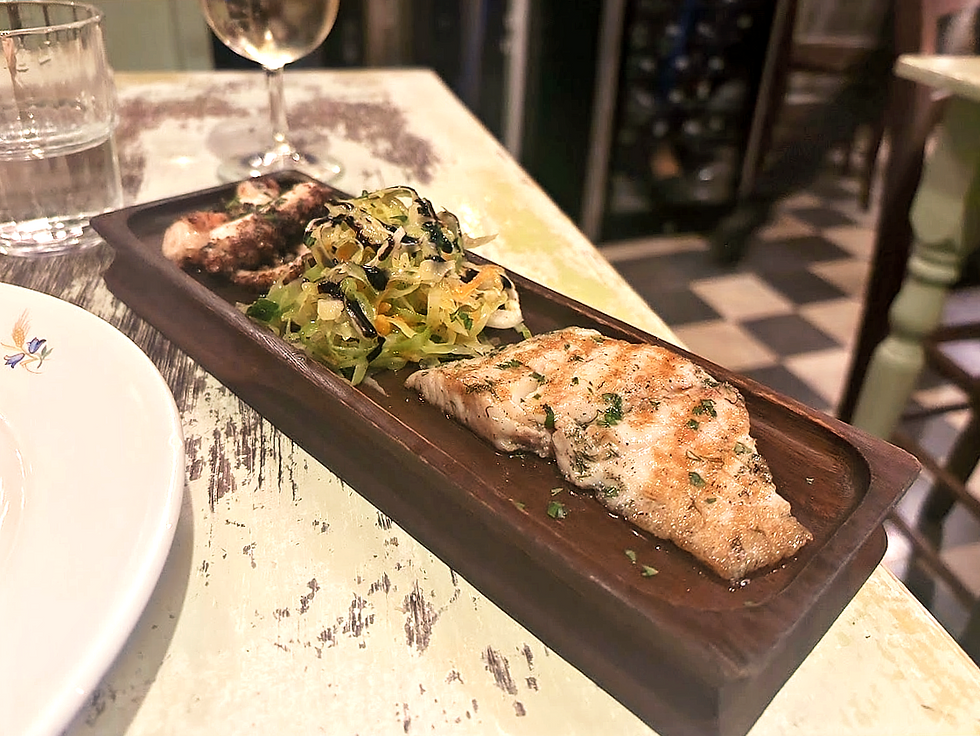
Freshly caught awrat (sea bream)grilled until the surface carried golden stripes. It shimmered under lemon and chopped parsley, oil catching the light.
Opposite it: octopus. Boiled first, then kissed by flame. Pale edges charred just enough.
Between them, a tight mound of cabbage slaw. The referee.
The sea bream was pure control. Flesh white and just-set, flaking at the suggestion of a fork. Moist to the point of indulgent. Not drowned in seasoning. Not overworked. Just heat applied correctly, which, in Malta, is rarer than we admit.
The octopus could have ruined everything.
It didn’t.
Tender. Actually tender. No rubber-band resistance. No aggressive chew. The garlic came through clean, not muddy. Meaty without heaviness.
And the slaw, sharp, acidic, pared down, reset the palate between bites. It wasn’t decorative. It was structural.
I moved through the plate quickly.
Not because it was small. Because it worked.
Here’s where the Michelin question creeps in again.
This isn’t innovation. It’s not avant-garde. There’s no foam. No reimagining of the coastline.
It’s product and restraint.
Fish treated with respect. Octopus cooked properly. Balance understood.
Sometimes that’s harder than invention.
I finished it and felt something shift.
Not satisfaction.
Expectation.
Because if this was the baseline, I wanted to see how far they were willing to push, without losing themselves in the process.
The Rosé That Behaves Like a Red
The next wine didn’t need a lecture.
Ta’ Betta’s Isabella Guasconi 2024.
If you’ve read me before, you know where I stand. I am shameless about this bottle. A rosé that behaves like it has something to prove. Pale, yes, but structured. Serious. The kind of wine that walks into a room quietly and leaves with the attention.
Thomas clocked my familiarity immediately. There’s a particular look sommeliers give when they realise they’re not starting from zero.
But he didn’t ease off.
He talked vintages, 2023 and 2024, he said, were the strongest yet. The blend evolving. The mine that was never meant to be. The gamble in every blind tasting when he pours it for other sommeliers and watches them hesitate, recalibrate, second-guess themselves.
A wild card.
That word lingered.
Because what landed next was mine.
A take on stuffed artichokes.
Stuffed artichokes are dangerous territory. Everyone has a version. Everyone thinks theirs is the correct one. I’ve eaten them my whole life and never attempted to cook them myself, because I know they’ll never taste like my mother’s.
I still remember her telling me how she and her siblings fought over the heart. The centre. The prize.
Traditionally: tuna. Breadcrumbs. Olives. Parsley. Dense. Savoury. Filling enough to replace dinner.
This one was different.
A neatly halved globe artichoke. Opened up. Filled with sun-dried tomatoes, fresh tomatoes, boiled egg, onion, chopped artichoke heart folded back into itself.
It looked modest.
It wasn’t.
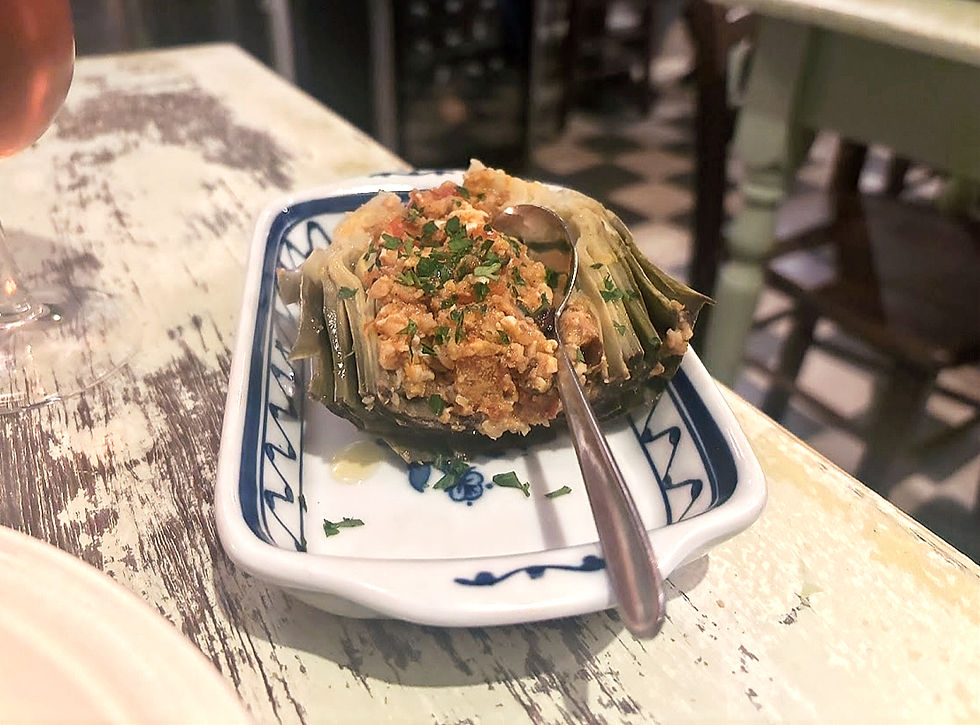
You don’t approach an artichoke with a knife and fork. You commit. Leaf between teeth. Scrape. Repeat. Fingers slick with oil and vegetable juices.
The leaves were tender, not collapsing, but yielding. The filling lighter than the versions I grew up with. Herbal. Bright. The egg giving structure without weight.
If I had to describe it, it sat somewhere between menemen and bruschetta, Mediterranean cousins meeting in the middle.
Juice ran down my wrists. Dripped toward my sleeve. I didn’t stop it.
Because somewhere in the middle of that artichoke, I crossed a line.
Up to that point, I was analysing. Observing. Measuring the room against the Guide.
Now?
Now it was about endurance.
Seven courses. Wine flowing. Bread constant.
This was no longer polite tasting.
It was defiance.
And I wasn’t about to blink first.
Where Malta Makes Its Argument
By now, the room had filled.
Tourists filtering in. Concept explained. First glasses poured. That cautious nod people give when they take their first bite somewhere the Guide has approved.
Every so often, someone glanced over at me, the solo diner who’d gone through five glasses and a basket of bread reduced to rubble.
When our eyes met, I gave them a look.
You have no idea what’s coming.
But you’re going to enjoy it.
The fifth wine arrived.
2024 Melqart Superiore from Meridiana.
If Bordeaux were born under a Maltese sun, this would be the result. Darker fruit. Forest berries. Sour cherry. Medium-bodied but structured, not a bruiser, but firm enough to signal a shift.
We had moved through whites. Through rosé with ambition.
Now the reds were stepping forward.
Then it landed.
Spaghetti bil-fenek.
A mound of pasta folding into itself, lacquered in deep red sauce, snowed over with grated cheese and flecked with parsley. It sat in a white bowl with a delicate blue floral rim, the kind your nanna might guard in a cabinet.
No tweezers. No negative space.
Just volume.
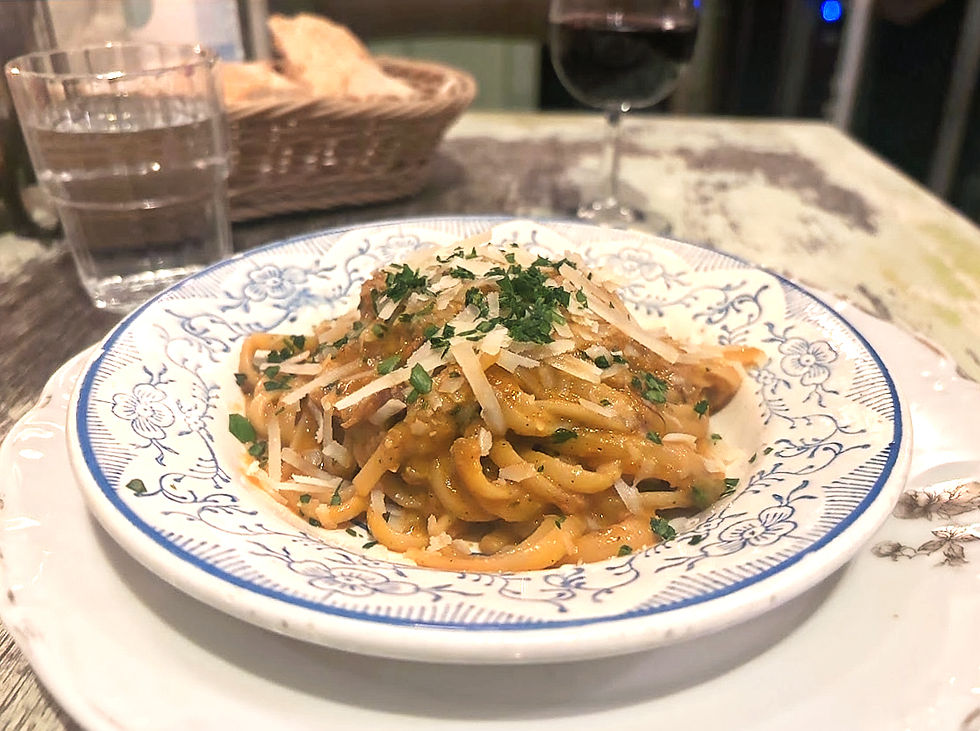
I pulled a spoon and fork from the basket beside me, because that’s how this is done, twirled a thick mouthful, and went in.
The pasta had bite. Not stiff. Not soft. Resistant enough to carry weight.
The sauce was slow-cooked honesty. Onion melted down into sweetness. Garlic present but not aggressive. Tomato reduced until it darkened and deepened.
And the rabbit.
Here’s where things can go wrong.
Rabbit can dry out. Toughen. Turn stringy and austere.
This didn’t.
It collapsed under the fork. Tender without disintegrating. Spiced carefully, bay, pepper, that faint herbaceous lift that keeps it from becoming heavy. Balanced. Assured.
There was so much sauce and meat that eventually the fork became impractical. I abandoned dignity and heaped the last mouthfuls onto the spoon.
Then the spoon failed too.
So I turned to the bread.
I chased every last streak from the bowl. No restraint. No performance of refinement. I’m not even particularly loyal to rabbit as a protein, but there I was, slightly feral, probably unsettling the polite couples beside me as I leaned in with the focus of a man who understands scarcity.
This is where Legligin makes its argument.
Michelin often rewards precision and restraint.
Spaghetti bil-fenek is neither restrained nor subtle.
It is generous. It is loud in its way. It stains. It demands.
And as I wiped the bowl clean and drained the last of the Melqart, I realised something:
If this dish doesn’t deserve a place in the Guide, then perhaps the Guide doesn’t fully understand Malta yet.
Endurance
By now, I was slowing down.
Not gracefully. Not strategically. Just physically.
It felt like being back at my nanna’s table (though it was my nannu who ruled the stove) where plates arrived in waves until you either surrendered or proved yourself worthy. Refusal wasn’t an option. Refusal was betrayal.
But I wasn’t done.
The next glass arrived.
2021 Markus Divinus Adon.
Thomas spoke about the man behind it like you speak about someone slightly unhinged but undeniably gifted. Small production. Bottles numbered individually. No safety net. No industrial polish.
I made a quiet note to hunt them down.
The wine carried a slight bitterness at the edge, not unpleasant, just assertive. Darker fruit underneath. Medium-bodied. Controlled. It didn’t shout. It held its ground.
Good.
Because the final savoury course was built for grounding.
Stuffat.
Local pork cheeks, stewed with cauliflower and broad beans, flanked by roast potatoes.
No reinterpretation. No deconstruction. Just a bowl that meant business.
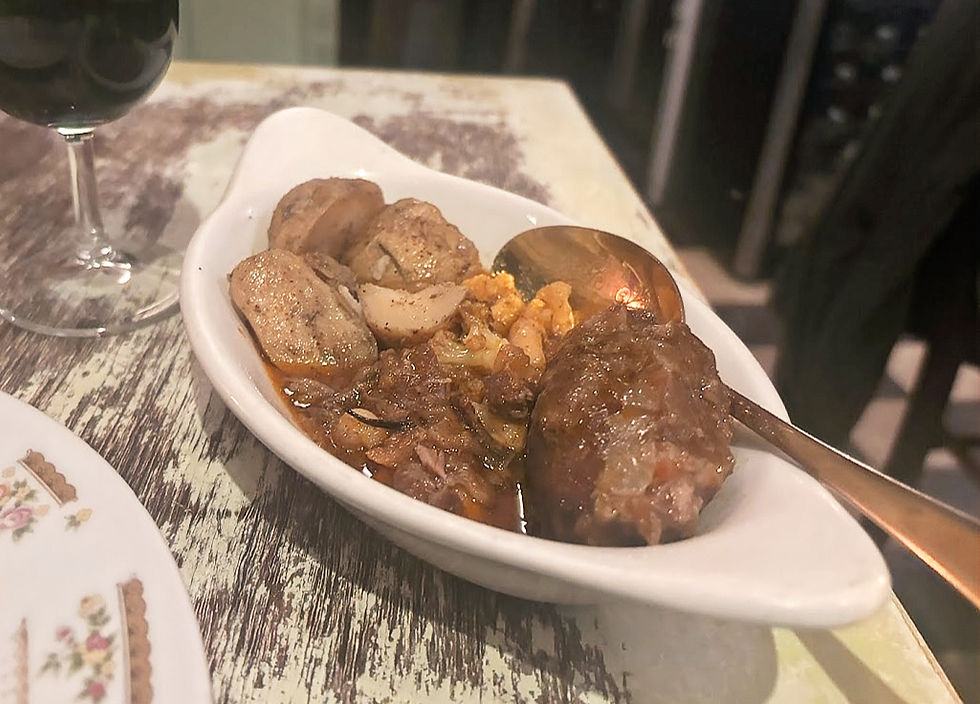
The pork cheeks barely required intervention. You could look at them and they threatened collapse. Long cooking had dissolved resistance into silk. This is what patience does to a cheap cut, it turns it noble.
The sauce was dense and dark orange, heavy with reduced tomato, onion cooked down until sweet and sticky, garlic threaded through it all, bay leaf humming quietly in the background. It coated everything. It demanded bread.
The cauliflower and broad beans weren’t garnish. They absorbed. They thickened. They made the dish feel anchored in soil.
The potatoes, roasted properly, edges catching, centres soft, provided just enough resistance to remind you that texture matters.
The Adon sliced through the richness cleanly, its bitterness acting like a reset button between bites.
This is the Maltese kitchen at its most honest.
Not plated for Instagram.
Not engineered for stars.
Cooked low. Cooked slow. Fed to you until you understand something about yourself.
I finished it.
Bread did its final duty, dragging through the last slick of sauce. I leaned back, finally admitting what my body had known two courses ago.
I was full.
Properly full. Slightly drunk. A little unsteady.
And there was dessert coming.
I could almost hear my nanna’s disappointment at the idea of refusing it. That sharp intake of breath. That quiet “okay mela.”
So I shifted in my chair. Rolled my shoulders. Exhaled.
Because this wasn’t just dinner anymore.
It was about endurance.
And I wasn’t about to quit before the final course.
Nothing Wasted
The final glass arrived heavier than the rest.
2024 Grand Vin de Hauteville Moscato from Delicata.
Not merely sweet. Technically a liqueur. Fortified. Armed.
It hit like apricot nectar laced with intent, lush, viscous, deceptively gentle on the tongue before the alcohol crept up and made your knees knock together under the table. A rarity. Almost a loss leader. The kind of bottle you pour for someone who claims sweet wines lack backbone.
This one has spine.
Dessert is the only course you’re allowed to choose.
Crème brûlée. Tiramisu. Safe ground.
I nodded at them respectfully and then pledged allegiance where it mattered.
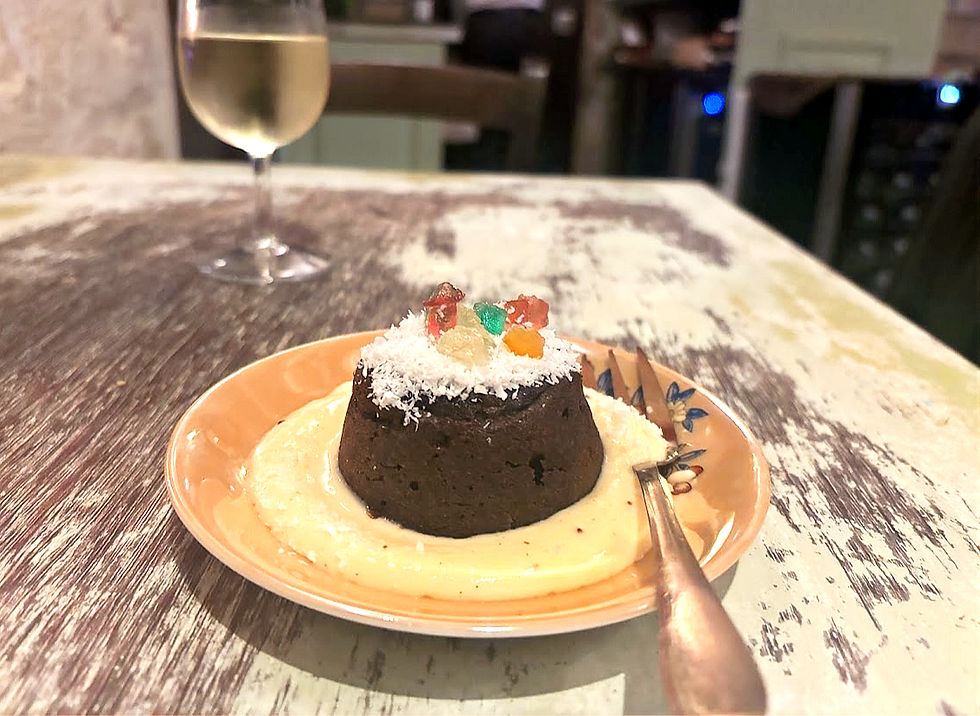
Pudina tal-ħobż.
Bread pudding.
The most Maltese way to end a meal, yesterday’s bread resurrected, soaked, sweetened, spiced, reborn. Nothing wasted. Everything redeemed.
Whenever I eat it, I’m back in a fluorescent-lit shop with my mum, splitting a square between us after errands. Plastic fork. Warm paper bag. No ceremony.
Here it arrived warm, almost too warm, floating in vanilla custard. Snowed over with desiccated coconut and studded with candied fruit like confetti that refused to dissolve. Dense. Dark. Perfumed with spice.
Not reimagined. Not refined beyond recognition.
Just done properly.
Eric Clapton’s Layla drifted through the room, slightly tinny, slightly nostalgic, and I didn’t wait. I dug in too soon and burned the roof of my mouth. I kept going anyway.
Sweet. Sticky. Spiced. The custard loosening the edges.
I finished it.
No bread left to chase the last streak of custard. For once, something remained on the plate.
I leaned back, wine glass nearly empty, room now loud with tourists in various stages of surrender.
Thomas knew.
He’d watched me slow down. Watched the bravado settle into effort. When he came by one last time and asked if everything was good, it wasn’t the rehearsed check-in of a dining room manager. It was the look of someone who’d seen this arc a hundred times.
He offered coffee.
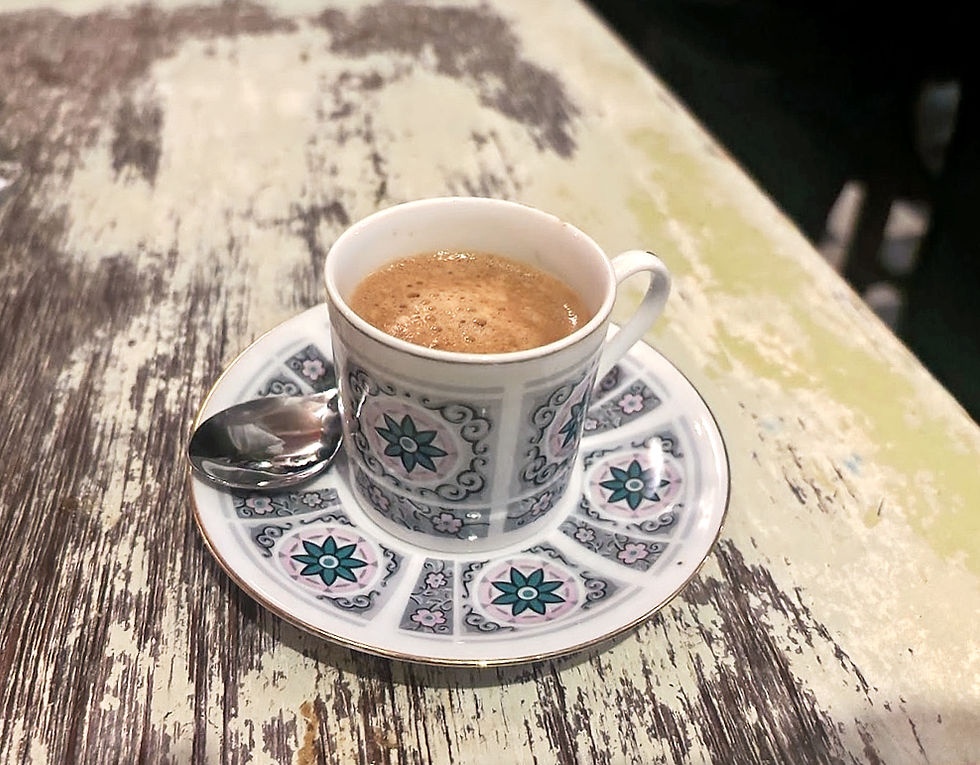
I ordered a double espresso.
It arrived in a tiny, ornate cup, the kind you’d expect to find in a Marrakech market stall rather than a Valletta cellar. Dark. Bitter. Necessary.
As I sipped, I looked around the room.
Tourists mid-surrender. Couples negotiating their final bites. Glasses tilted at uneven angles. Bread baskets depleted.
And I asked myself why I was here.
Verdict
I wasn’t here for nostalgia.
I wasn’t here for comfort.
I was here to decide whether Michelin was right.
Is this worthy of the Guide’s nod?
Here’s what I know.
This is Maltese dining without apology. The food. The wine. The abundance that borders on aggression. It’s refined, yes, but never sterilised. You won’t find laminated menus or exhausted bragioli passed off as tradition. You won’t find imported theatre masquerading as culture.
Produce is local. Wines are Maltese. The family has run this place for two decades. They’re not guessing anymore. They know their rhythm.
This is home cooking scaled to a professional kitchen without losing its pulse.
And that matters.
Because Legligin does not cook to impress Michelin.
It cooks like family is coming over and there’s no such thing as “too much.”
The Guide has recognised it. Recommended. Not starred. Not elevated into rarefied air.
Just acknowledged.
Before the bill arrived, a tiny shot glass of limoncello appeared, made in San Blas, in some inherited field I’d never heard of until that moment. Sharp. Sweet. One final nudge.
The bill came to €88.
€48 for the tasting menu.
€40 for the wine pairing.
For seven courses. For a tour of Maltese vineyards. For bread that never left the table.
Thomas had quietly comped some drinks. I tipped accordingly.
I walked back into Valletta the way I leave my grandmother’s house: full to the brim. Slightly unsteady. Sweating through my shirt. Content but aware of the excess.
And I realised something before I ever sat down to write this.
Legligin isn’t chasing a star.
If anything, it feels more aligned with a Bib Gourmand, serious cooking, honest pricing, no theatrics. Four years recognised, and instead of escalating into spectacle, it’s chosen continuity.
But it absolutely deserves its place in the Guide.
Because if Michelin is going to claim it understands Malta, it must recognise that greatness here doesn’t whisper.
It feeds you until you surrender.