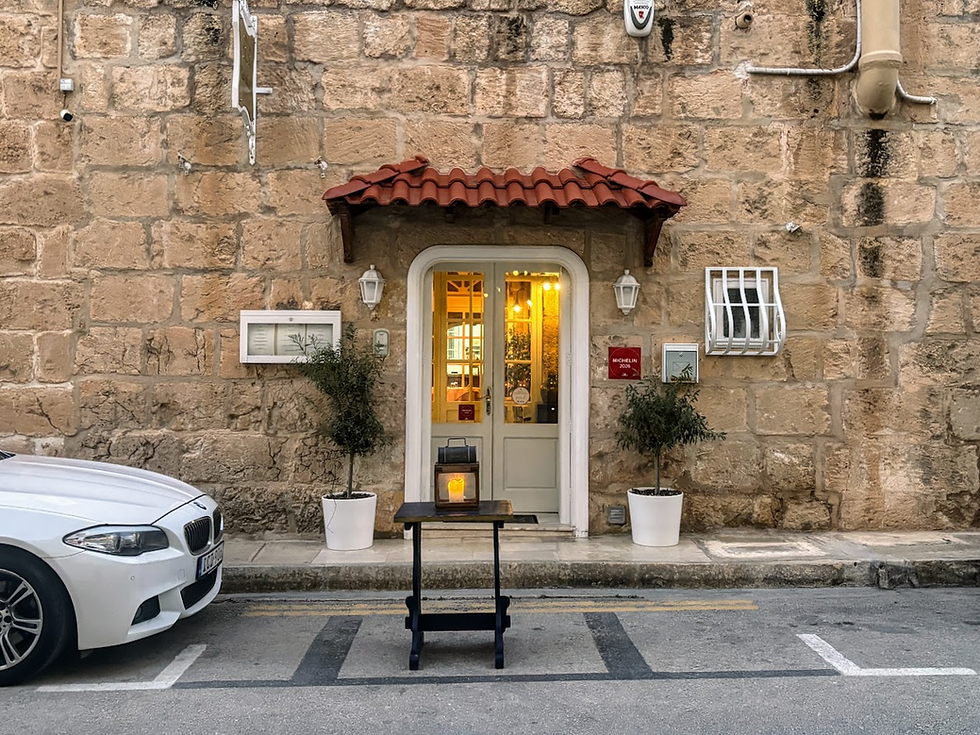
Sub-terranean, sub-par
- Feb 20
- 9 min read
Restaurant: Grotto Tavern, Rabat
Visited on: February 9, 2026
Instincts
Humans have spent thousands of years learning how to sense danger. A rustle in the bushes. A shift in the wind. Something not quite right.
I like to think I’ve developed a similar instinct, not for predators, but for restaurants about to disappoint me.
For our ancestors, a sudden silence in the forest meant run. For me, it’s a fine dining bar that looks hastily stocked, bottles strewn about like an afterthought. The kind of detail that whispers: no one is really in control here.
Walking down the narrow steps into the dim foyer, my gut tightened.
The room looked tired. Not charmingly worn, just tired. Half-empty bottles leaned against each other on the shelves. Christmas decorations still lingered on a cocktail table, clinging to relevance well past their season.
Above the kitchen entrance hung two Michelin plates, polished, proud, and directly beneath them, patches of plaster slapped on with all the finesse of a teenager hiding a love bite before school.
The hostess smiled and welcomed us in, guiding us through the restaurant until we reached the top of the steps leading down to the infamous grotto. There, we were informed that there was no reception, shown the location of the bathrooms, and gently ushered onward.
A faint dampness hung in the air. The humid scent of natural stone filled my nostrils. It was, after all, a thousand-year-old cave. I decided to grant it that small mercy.
Three tables were already occupied, each hosting couples at very different stages of both their meals and, it seemed, their relationships. In the low light, I could just make out the outlines of faces and the occasional flicker of glassware. More Christmas decorations lingered in the background, quietly overstaying their welcome.
The dining room featured what I counted as six different styles of chairs. Presumably eclectic. In practice, it looked like the aftermath of a family gathering where everyone was told to bring something to sit on.
To be clear, I am not some wine-soaked purist who only dines under chandeliers. Some of my fondest meals have been plates of chicken feet and laksa at Maxwell and Newton food centres. Simple food done well will always beat theatrics. But when Michelin plates hang on the wall and the tasting menu costs one hundred euros a head, a certain standard feels less like snobbery and more like expectation.
We were seated at a table at the foot of the stairs. An LED lamp perched in the centre, straining bravely against the surrounding darkness. It succeeded in illuminating the tabletop. Unfortunately, it also revealed the crumbs and dust that appeared to have arrived before we did.
The waitress hurried off to retrieve our menus.
Ceremony
On the table sat a neatly folded cloth napkin, our cutlery resting on top like it had been carefully tucked in for the night. Behind it lay a leather roll. Inside, the menu.
It had once been sleek. Heavy paper stock, clean type, the kind of thing that suggests confidence. Now it cracked slightly at the folds, the edges softened from years of rolling and unrolling. It felt less like patina and more like neglect. The cocktail list was in even worse condition, barely holding itself together at the seams.
We knew why we were there. The seven-course tasting menu, the supposed crown jewel. For a brief moment, given the omens so far, I considered retreating to the safer prix-fixe. Instead, I committed. If you are going to test a place, you may as well test it properly.
After the ritual question of still or sparkling water, and the ordering of a 2023 Marnisi, we settled in for the journey.
The sommelier, who also appeared to double as maître d’, arrived to open the bottle. He did so with the quiet efficiency of someone who has performed the same gesture thousands of times. There was no flourish, just repetition honed into muscle memory.
Then came the amuse-bouche. My gut tightened again.
Four slices of bread arrived first, each cut at a slightly different angle. Let us call it an intentional rolling cut. Alongside it, a shallow dish of “cultured” butter dusted with salt.
Two small brioche tartlets filled with chicken liver parfait followed, undeniably handsome, though placed slightly off-centre on the plate. Finally, a small bowl containing a pale, mousse-like substance topped with puffed barley. It looked serious.
Possibly too serious.
As a born and bred, bread-loving Maltese citizen, I began where any self-respecting Maltese would. The bread and butter. Whether it is Lurpak and pre-sliced Maltese loaf or sourdough with lobster-infused butter, this is the true beginning of any meal.
The butter resisted slightly under the knife. I carved out a portion and spread it generously. The bread itself was airy with a good crunch. Promising. Unfortunately, the theatrical flourish of salt scattered across the butter tipped the balance too far.
The first bite was less nuanced dairy and more sodium.
We soldiered on.
The Opening Movements
Next came the chicken liver tartlets, each roughly half a bite. They opened, once again, with a sharp hit of salt. Then the parfait settled in, rich and smooth, and the flavour rounded out into something genuinely pleasant. Brief, but satisfying. A small reprieve.

Then we turned to the bowl.
In pursuit of the perfect bite, I dug my spoon deep, making sure to gather barley, brown mousse, and the hidden white cream in one calculated scoop.
The mysterious mousse revealed itself.
Mushroom.
Not earthy. Not layered. Not wild. Just mushroom. Suspended somewhere between a duxelle and a cautious mushroom soup, it presented no real dimension beyond its primary ingredient. I tried again. More cream this time. Then more barley. I let it linger on my tongue, searching for depth, for acidity, for anything that might shift the experience.
Nothing moved.
It remained stubbornly one-note, evoking memories of my grandmother’s mushroom soup poured from a thermos at Sunday lunch. Comforting, perhaps. But not something that justifies ceremony.
The aftertaste lingered unpleasantly, so we returned to the bread for repair. With most of the theatrical salt flakes now gone, the butter tasted balanced enough. Plain, but serviceable.
Our plates were then cleared in a mild hurry, crusts tumbling to the floor in the process. Given the debris field left behind, a quick wipe of the table would have felt appropriate. Instead, fresh cutlery was laid directly onto the battlefield of crumbs, readying us for the second course.
The second course arrived almost immediately. Before getting into it, a brief detour on plating. Specifically, that wide-rimmed, shallow-bowled plate that dominated restaurants sometime around 2015. You know the one. It looks like the underside of a flying saucer and turns anything placed in it into a distant relative of soup.
Three separate dishes over the course of the evening would appear in this same vessel, regardless of their structure or intent. All flattened into the same aesthetic. It is an awkward plate to eat from, visually dated, and stubbornly unimaginative. If there is excess stock lingering in storage somewhere, I beg that it be retired.
Now, the tortellacci.
Three parcels filled with gbejna, crowned with a pale foam and a single cooked sage leaf. White cream on pale pasta, served in a white bowl. Subtlety is one thing. Camouflage is another.

The pasta itself was excellent. Rolled thin, evenly cut, cooked properly al dente. No complaints there. The filling, however, behaved like a small pressurised device. Once cut, it spilled enthusiastically across the bowl, forcing the pumpkin chutney and the consommé beneath it to merge into something unintended.
The problem was logistical as much as culinary. A broth pooled at the base, yet I had been armed only with a knife and fork. Extracting the consommé required either finesse or mild desperation.
The filling leaned salty, which is perhaps inevitable with gbejna, but it found some balance in the sweetness of the pumpkin. The broth, in the few mouthfuls I managed to capture, was clean and pleasant.
Overall, it was a good dish. Competent. Structured. Thoughtful enough.
But nothing that altered the trajectory of the evening.
I told myself it might be a restrained opening movement before a crescendo. Still, the earlier omens lingered.
Echoes of Innovation
The next dish was the one that had caught my eye when scanning the tasting menu.
Snail.
In Malta, snails are rarely dressed up. They are small, stewed patiently in tomato sauce, served at fenkatas and mallajatas. Rustic, rich, unapologetic. This version promised something more ambitious. Something reimagined.
The table, still scattered with crumbs from earlier courses, received another of the now-familiar wide-rimmed plates.
At its centre sat a pale cream, topped with what we were told was hay. Resting above it were alternating shell-less snails and neat white cubes of jelly. Beneath it all, meticulously cut cubes of potato and apple.

Visually, it felt like a relic from another culinary era. The jelly cubes carried a faint echo of 1990s Marco Pierre White-esque bravado, the kind of flourish that once felt daring. Now it reads as dated.
The first bite was immediately compromised by the hay, which was far too rigid. It scratched rather than complemented, bringing to mind the unpleasant grit you encounter when snails have not been properly cleaned. Texture should intrigue. This irritated.
Temperature did not help. The dish was neither warm nor cold, but stuck somewhere in between. Warm enough to suggest intention. Tepid enough to frustrate.
The snails themselves were subdued. The cream muted them further. The jelly added little beyond nostalgia. The potato and apple cubes were pleasant, but competence at that level should be assumed.
This felt like a dish that might once have been bold. Perhaps even seductive. Over time, though, something had dulled. Corners softened. Trends moved on. What remained was not innovation, but an echo of it.
Then came the quail, accompanied by a welcome change of plateware.
A small breast, roughly the size of a chicken tender, lightly charred across the top. Beside it sat a thick slice of boudin noir, a streak of prickly pear gel, and what can only be described as a slab of compressed flaxseed. The jus was poured tableside, adding a moment of theatre that the evening sorely needed.

As before, I assembled what I hoped would be the ideal bite.
As before, salt arrived first.
The quail itself was properly cooked, tender and yielding. Perhaps it had been brined. Perhaps the seasoning was simply heavy-handed. Either way, the balance tipped too far.
The boudin was competent. Rich, earthy, but unmemorable. The flaxseed slab, however, was something else entirely. Dense, rigid, closer to construction material than garnish. I approached it cautiously, half expecting to schedule a dental appointment the following morning.
Texture, once again, seemed to exist for its own sake. The dish felt assembled according to a formula: something soft, something crunchy, something sweet. But cohesion is not achieved through contrast alone. It requires intention.
At best, the plate was serviceable. At worst, forgettable.
We finished what we could, leaving the flaxseed behind for sturdier souls.
Between courses, a rowdy Italian couple took their seats nearby. They were clearly well into their wine pairing, growing louder and more affectionate with each refill. Nothing inappropriate, just present enough to become part of the soundtrack. Had I understood more Italian, I suspect I could have followed their entire evening.
The Supposed Crescendo
Then, finally, a dish that suggested we might be turning a corner.
Heritage beef. The supposed centrepiece. The crescendo I had been waiting for.
A neat round of beef, cooked closer to medium-well than the blushing medium-rare most kitchens aim for. Alongside it sat a quenelle of parsnip purée and a compact, sandwich-loaf-shaped carrot preparation, topped with quartered miniature Brussels sprouts. A pool of jus tied everything together.
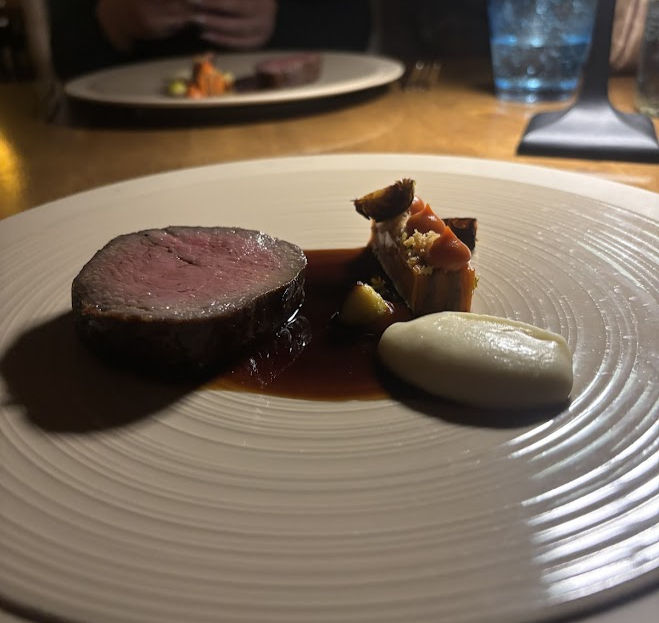
On paper, this was the moment.
The beef itself was tender, yielding easily under the knife. The parsnip purée was smooth and generously seasoned, with a sweetness that complemented the richness of the meat. It was comforting. Competent.
The carrots, however, sat in an awkward middle ground. Not raw enough to be intentionally crisp. Not cooked enough to be tender. Just shy of where they needed to be. The Brussels sprouts added structure, but little else.
Nothing on the plate was offensive. Nothing was careless. But nothing quite soared either.
For a course positioned as the star, it felt more like a reliable supporting actor. Pleasant, capable, but unlikely to linger in memory.
No Encore
As the plates were cleared, we were offered the cheese course. Given the trajectory of the evening, we declined and moved directly to dessert.
The final act. The moment meant to leave you suspended in memory.
It arrived with a grand name: The Orange Opera. The implication, of course, being a refined nod to opera cake. The plate, however, was the now-familiar wide-rimmed saucer.
At its centre sat a neat square of layered sponge, cream, and orange jelly. Structured, precise, almost architectural. It bore an unfortunate resemblance to the sort of pre-cut trifle squares found at the dessert station of an all-inclusive hotel buffet. Brown, white, and orange in tidy strata. On top, a rigid crisp added height and texture. A quenelle of ice cream leaned against it, resting on what were described as “orange rocks,” though they looked suspiciously like cheese puffs.

The rocks were, in fact, the best part. Bright. Zesty. Confident.
The rest was serviceable.
The sponge was fine. The cream competent. The jelly present. But nothing stirred. Nothing lingered. It felt assembled rather than composed. A dessert that closed the meal without elevating it.
We declined coffee. Petit fours arrived regardless, including a madeleine that leaned decisively toward dry. We smiled, thanked the staff, and stepped back into the night air.
A Pattern, Not a Misstep
I do not take pleasure in writing this. Running a restaurant at this level is relentless work. Off nights happen. Kitchens stumble. That is understandable.
What felt more troubling here was not a single misstep, but a pattern. Dishes that hinted at former ambition. Ideas that once might have felt daring. Details left unattended. A dining room that seemed to have paused in time.
Perhaps the chef has shifted focus. Perhaps the spark dimmed slowly. The maître d’ remains, steady and professional, but the place feels short of attentive hands.
Apart from genuinely friendly service, little justified the cost or ceremony of the evening.
Next time, I will trust my instincts.