

No Boarding Pass Required
Restaurant: Agora, Ta' Xbiex
Visited on: February 15, 2026
The rain had been battering Ta’ Xbiex for hours by the time we got there. Wind coming off the water hard enough to tilt umbrellas sideways. The promenade slick and shining like a freshly gutted fish.
We’d been to Agora before. Quick. Distracted. Polite.
This time we came back hungry.
The terrace was sealed off in thick plastic sheets that snapped and shuddered every time the wind hit. Inside, though, it was another country. Not metaphorically. Not “inspired by.” Another country.
Foça. The old coast outside Izmir where the sea is flat and metallic in the morning and every table somehow ends up with a bottle of raki sweating into the wood.
The ceiling above us was draped in white linen, not showroom white, but that slightly lived-in white that catches the light unevenly. Nazar boncuğus hung everywhere. Dozens of them. Blue glass eyes staring down, warding off envy, warding off something. These days you see them dangling from the necks of people who think they discovered them on Pinterest. Here they felt less decorative, more protective.
The chairs were wicker, painted in that stubborn Aegean blue. The tables were dressed in white linen, properly pressed, sharp at the folds, the kind of linen that tells you someone cared enough to run a hot iron over it before service. Not staged. Prepared.
And then it happened.
From somewhere behind the pass came the smell of grilled meat hitting metal. Butter warming. Bread toasting just past pale. A sharp note of anise drifting from a table nearby where someone had already committed to raki despite the weather.
The rain kept hammering the plastic walls, but inside you could hear teaspoons tapping against narrow-waisted çay glasses. The small, bright clink of sugar dissolving. Ice knocking against glass. A burst of Turkish from the kitchen, fast, casual, unselfconscious.
That’s when the storm disappeared.
Not because it stopped. Because it stopped mattering.
For a moment, Ta’ Xbiex wasn’t Ta’ Xbiex. It was late afternoon on the Aegean coast, the table filling slowly, the light stretching itself thin before sunset. The kind of place where you sit longer than you planned, order one more thing than you meant to, and let the outside world deal with itself.
And outside, the Mediterranean kept throwing a tantrum.
The Ritual of Yoghurt
We didn’t need the menu. Not really. We already knew how this had to begin.
Meze. Always meze.
Three dips: cacık, or tzatziki, if you lean Greek, atom, and girit ezme. Turkish cuisine doesn’t drown everything in yoghurt the way outsiders assume, so when it does appear, it feels deliberate. Almost ceremonial. We lined up the lactose pills like responsible adults and then ignored responsibility entirely.
The tableware, all blue glaze and clean white, pushed the illusion further. This wasn’t accidental décor. It was staging. A teleportation device disguised as lunch.
The dips arrived on a vivid blue plate that looked like it had stolen its colour from the Aegean.

The cacık came first, thick but not heavy, garlic forward without being rude about it. The yoghurt had body. It clung to the cucumber instead of slipping off. Cold, sharp, alive. Not the diluted, watery stuff that shows up beside kebabs as an afterthought.
The atom followed, and this one didn’t ask permission. Butter-fried cayenne bled into the yoghurt in streaks of red and orange. The heat crept up slowly, then settled behind the eyes, not enough to make you cry, just enough to make you aware of your own pulse.
Then the girit ezme. Crumbled cheese worked with olive oil and herbs until it became something between a spread and a loose paste. Green flecks throughout. Salty. Slightly tangy. Familiar in the way pesto is familiar, but looser, sunnier, less polite.

And the bread, soft, warm, still breathing when it hit the table. You tore it open and steam slipped out. The crust gave way without a fight. This wasn’t a side note. It was the engine. You dragged it through yoghurt and chilli butter and oil until your fingers shone.
Outside, the storm kept raging.
Inside, we were already somewhere else.
The Point of Excess
While we were still elbow-deep in yoghurt and chilli butter, the rest of the starters began landing. We had not exercised restraint. Three more plates. Same blue-and-white universe, different shapes, shallow bowls, wide platters, something curved like a boat.
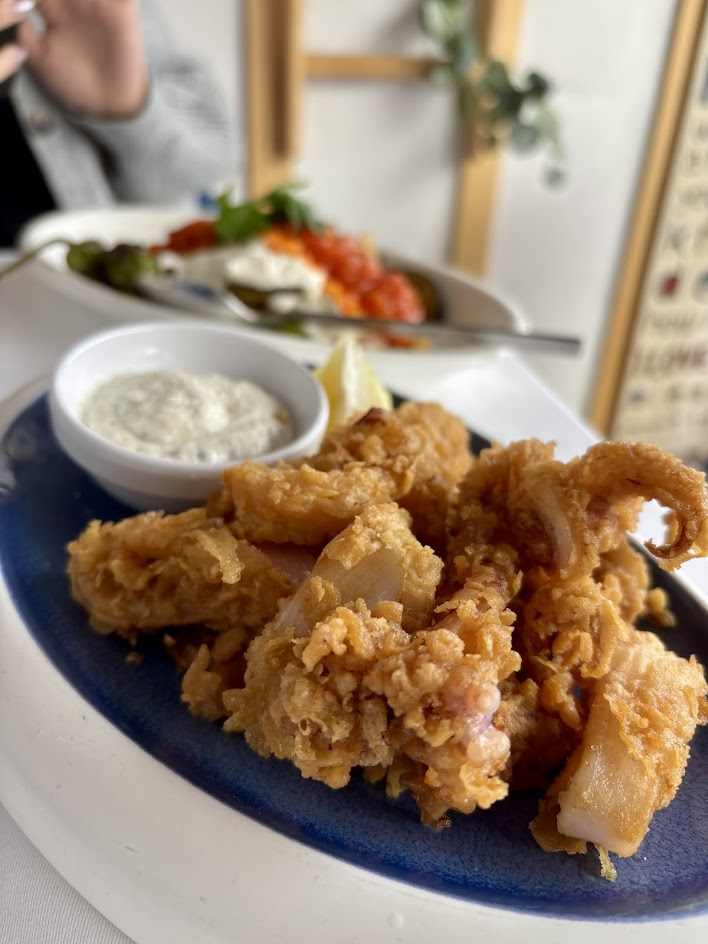
First: fried calamari.
Maybe not textbook Turkish. Maybe something borrowed from the wider Mediterranean playbook. But here’s the thing, you trust a Turkish kitchen with seafood. It’s in the blood.
The rings were pale gold, not the dark, oil-heavy brown that signals regret. You bit through the crust and it shattered cleanly. Inside, the squid gave way without resistance, no rubber band recoil, no chew-fest. Just soft, sweet flesh that disappeared almost too quickly. The coating stayed crisp all the way to the bottom of the pile. No soggy graveyard underneath. A small mercy. A rare one.
Next came yogurtlama, fried vegetables and potatoes buried under yoghurt and a deep, slow-cooked tomato sauce. (Yes, the yoghurt again. We were committed now.)
The vegetables had collapsed just enough, edges softened, centres still intact. Warm spice threaded through them, not aggressive, but present. The tomato sauce was sweet in that sun-reduced way, almost jammy, and the yoghurt cut through it like a cool blade. Heat. Acid. Fat. Repeat.

Then the manti.
If tortellini grew up by the Aegean and developed a superiority complex, this would be it. Small parcels, tight and deliberate, holding a filling that leaned into warmth; spice that bloomed rather than shouted. Cumin, maybe. Paprika. Something deeper underneath. Again the yoghurt. Again the balance. Again that dance between richness and restraint.

At this point the table was crowded. Plates overlapping. Bread torn into uneven chunks. Fingers slick with oil and sauce.
Did we over-order?
Of course we did.
Did anything survive?
Not a chance. We chased the last streaks of tomato and yoghurt across porcelain with bread, wiping plates clean in the way that would horrify a fine-dining maître d’ and deeply please any grandmother worth her salt.
Outside, the rain kept punishing the pavement.
Inside, we were conducting damage of our own.
Cities on a Plate
Truth be told, we could have stopped there. Paid the bill. Walked out smug and full and slightly lactose-impaired.
But I was not raised to retreat mid-feast.Our waiter, with the patience of a man who has seen this mistake before, asked if we needed a moment.
We did not.
Two mains. Two cities. Bodrum and Istanbul, both now summoned to Ta’ Xbiex.
First: çökertme kebab.
A reckless construction. A foundation of thin, crisp fried potatoes, not chips, not fries, something in between, forming a golden lattice on the plate. Over that, tender strips of marinated meat, collapsed into themselves, soaked in a deep red sauce that bled into everything below. Garlic threaded through the whole thing, not subtly. On the side, a long green pepper blistered and collapsing, and a wedge of tomato doing its best to look innocent.
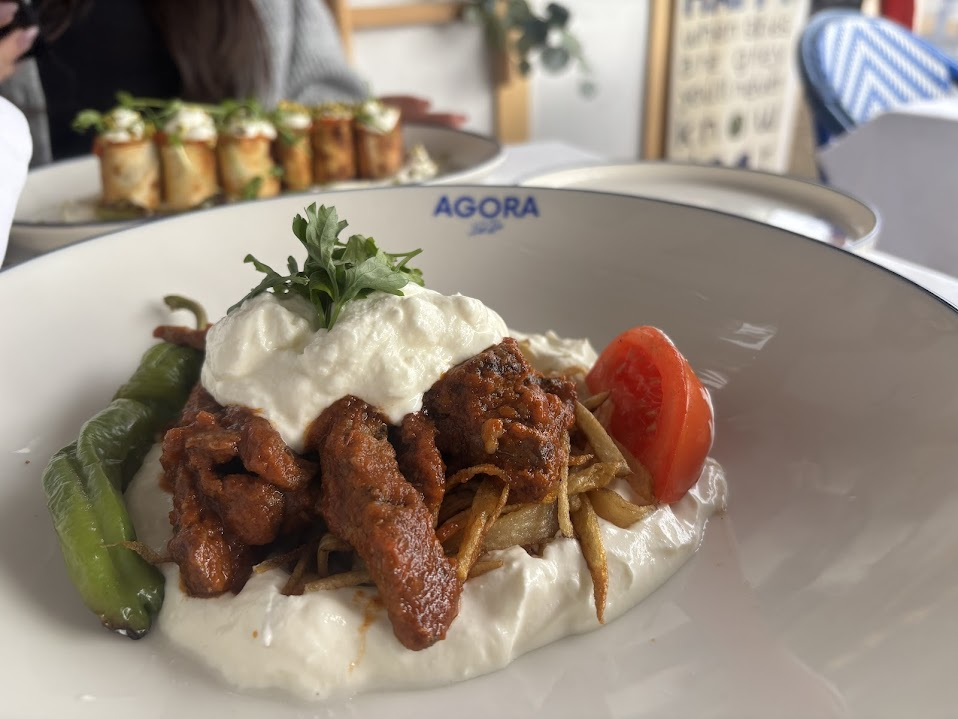
You break into it and the structure gives way. The potatoes soften under the sauce but keep just enough crunch at the edges. The meat falls apart with barely a fight. It’s rich in that unapologetic, seaside tavern way. And then, again, the yoghurt. Cool. Clean.
Cutting through the fat like a referee stepping between two heavyweights.
It’s not delicate food. It’s food that knows exactly what it is.
We finished it faster than we meant to.
Then came the one we’d been thinking about since our last visit: beyti kebab.
Adana kebab, warm with spice, deeply seasoned, wrapped tightly in lavash, sliced into neat little spirals and laid over a generous bed of yoghurt. A streak of sauce across the top. The same faithful green pepper. The same tomato.
But this is where things get clever.
The juices from the kebab had seeped into the lavash, turning it crisp at the edges but saturated within. You bite through a slight crunch and hit a core of spice and meat and sauce all at once. It’s heavy. It’s sweaty. It demands attention.

And then the yoghurt steps in again. Not as garnish. As control. As balance. Turkish cooking flirts constantly with excess, fat, heat, meat, but it never quite tips over.
There’s always something cool waiting to pull it back from the brink.
We sat there, plates nearly wiped clean, fingers shining, slightly breathless.
Outside, the storm was still trying to prove a point.
Inside, we’d already won.
Shattered Pastry
We were full. Uncomfortably so. The kind of full where you loosen something discreetly and pretend you’re fine. And yet, naturally, we asked for the dessert menu and two glasses of çay.
Our waiter didn’t hesitate.
“Pistachio cream crunch,” he said. His favourite.
We surrendered.
What arrived looked like mille-feuille that had gone to Turkey for a summer and come back louder. Sheets of baklava pastry stacked high, brittle and golden, holding thick layers of pistachio cream between them. On the side, a neat scoop of ice cream and a few slices of strawberry, almost decorative, almost unnecessary.
And pistachios. Everywhere. Crushed, scattered, blanketing the plate so generously that I briefly wondered about their monthly nut budget.

Now, before the spoon goes in, we need to talk about the cream.
The kitchen at Agora wasn’t playing.
This wasn’t that fluorescent green paste piped into croissants and smeared along milkshake glasses across the island. Not that sugar-heavy, almond-adjacent imposter pulled from a plastic tub.
This was pistachio. Cream.
Dense. Custard-thick. The colour of actual nuts, not food dye. Tiny fragments of pistachio running through it. It tasted roasted. Real. Slightly savoury at the edges, the way pistachios are when they’re left alone to be themselves.
Take notes.
Back to the crime scene.
The spoon hit the pastry and it shattered instantly, that dry, delicate crackle of proper baklava sheets. I carved out a bite with everything: cream, pastry, ice cream, pistachio rubble.
It was excessive. Sweet, yes, but balanced by that faint nuttiness underneath. The cold ice cream against the crisp pastry gave it a strange, nostalgic edge. For a split second it reminded me of sugary childhood cereal eaten too late at night, but reengineered by someone who actually knows what they’re doing.
We were beyond full. We were operating on pride alone. And still, we kept going. Every last shard. Every last crumb of pistachio.
By the time the çay arrived, small glasses glowing amber, we leaned back in our chairs, defeated and victorious at the same time.
Digestion, after all, is strategy.
Counterfeit vs. Real
I’ve been lucky. I’ve spent time in Türkiye, Izmir, Antalya, Istanbul. I’ve even eaten Turkish-ish food in Baku. One of my closest friends, unmistakably, unapologetically Turkish, shaved a döner kebab at her wedding instead of cutting a cake.
Iconic behaviour. Aspirational, even.
The first time I landed in Izmir and started eating properly (guided by my abovementioned friend), something clicked. Or maybe something snapped. I realised how thoroughly we’d been sold a counterfeit back home. We call those rushed, overstuffed wraps, padded with fries and mystery sauces, “Turkish.” And listen, I’ve inhaled more than a few of them at 2 a.m. without complaint.
But it’s not the same thing.
Even a simple kebab wrap in Izmir tasted deliberate. The meat juicier. The bread softer, thinner, almost elastic. The balance intentional. Nothing thrown in to bulk it up. It felt like I’d spent years eating a photocopy of the real document.
And every time I came back from Türkiye, I carried that quiet frustration with me. The knowledge that if I wanted that flavour again, that clarity, that balance of heat and yoghurt and smoke, I’d need to book a flight and pay Turkish Airlines for the privilege.
But now?
Now it’s a fifteen-minute drive.
Agora isn’t a late-night döner stop with fluorescent lights and a laminated menu. It’s not there to mop up your bad decisions. It’s there to remind you what the real thing tastes like.
And for once, we don’t need a boarding pass.